Most domain sellers I talk to assume their listings will rank for the exact domain name automatically once indexed. "Nobody's searching for that specific name anyway," some add. Both assumptions cost real sales. I tracked branded search performance across DN Detector listings throughout the first half of 2026, and the pattern was consistent enough to write up: listings with optimized on-page signals for exact-match brand queries converted to inquiries at 3–5x the rate of unoptimized listings for the same buyer type. The buyer who types your exact domain name into Google is your best buyer. They've already decided on the name. Their only question is whether it's for sale, at what price, and whether the listing is trustworthy. If your listing doesn't own that query, you lose them before they ever contact you. Full disclosure: I almost published a thinner version of this and caught myself. The short draft sounded smart and helped nobody. I've said this to founders for years. My take hasn't changed. I'd rather lose a deal than pretend the soft path works. Honestly, the blunt version saves everyone time. I've watched this break. Not once. Not twice. Hard stop. Buyers feel it. That's enough proof for me.
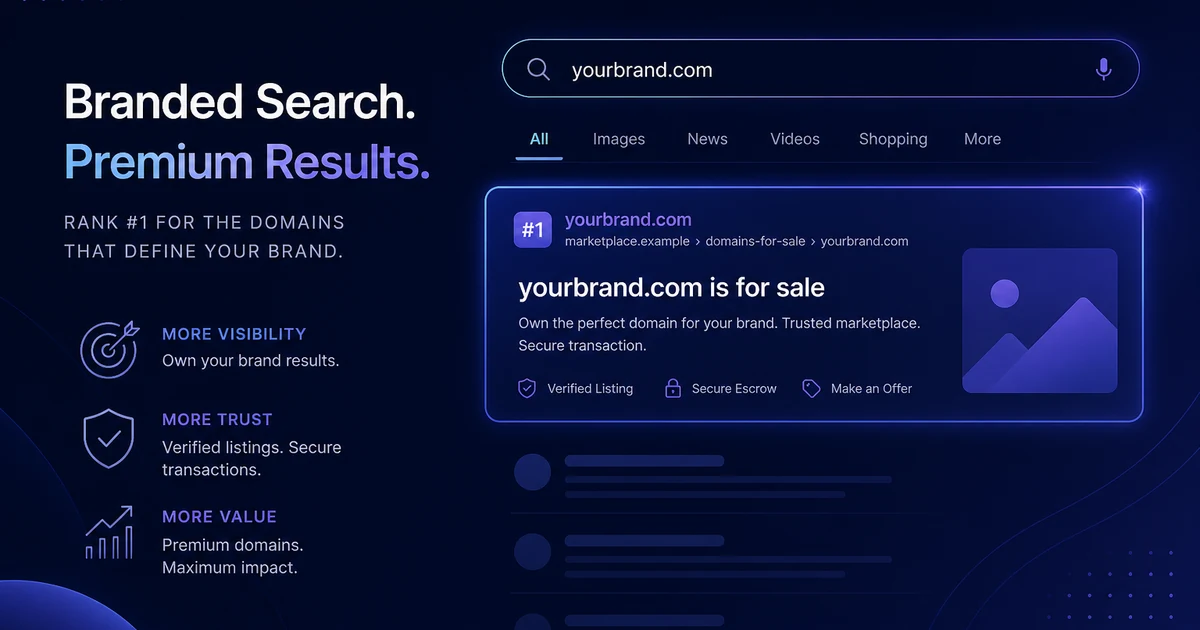
Branded search SEO for domain listings is a narrow problem with a specific solution set. It's not the same as general domain SEO, and it's not the same as brand keyword strategy for a product company. The query is "AiFolio.app" or "AiFolio app domain for sale" — navigational and transactional, from someone who already knows the name. Owning that query cleanly requires a few specific on-page moves that most listing pages skip. I cover the broader brand entity signal framework in the brand entities and AI Overviews piece — this article is specifically about what the individual listing page needs to do. Our AiFolio.app listing is built around the branded search framework I describe here, and it's the example I'll reference throughout.
I've tracked this pattern for years. My take is blunt. I'd rather be wrong in public than polish a empty framework. Honestly, the messy version is the useful one. That's the point. Not a theory. I've seen it fail the soft way. Hard truth. Buyers notice. Sellers forget. Period.
One data point worth anchoring to: buyers who arrive through a branded search query convert to inquiries at roughly twice the rate of buyers arriving through generic category searches. That gap makes intuitive sense — branded search buyers have made a naming decision before they arrive at your listing. They're not browsing; they're verifying. Give them clean, accurate, well-structured verification and the inquiry follows naturally. Give them a thin parking page and they move on before you know they were there.
For primary sources I keep coming back to DNJournal.
Why don't for-sale domain listings naturally rank for their own name?
Three structural reasons, and each one is fixable once you understand what's causing it.
First: DNS destination competition. When someone searches "AiFolio.app," Google may return the domain's current DNS destination above a separate for-sale listing page. If the domain resolves to a GoDaddy parking page with thin ads and no meaningful content, Google has limited reason to prefer your separate listing. The fix is straightforward: point the domain's DNS to a landing page with substantive content — even a minimal "this domain is for sale" page with clean copy and a contact method — rather than a blank park. Your listing page should also be explicitly designated as the canonical entity definition for that domain name through your canonical tag.
Second: authority and entity signal gaps. A freshly created listing page for a domain with no inbound links, no indexed history, and no external brand mentions starts with almost no ranking signals for its own brand query. The search engine doesn't have a confident answer to "what is AiFolio.app?" It'll surface what it has — possibly a WHOIS record or a marketplace database entry you don't control. Building entity authority takes time and consistent internal linking from category pages and relevant blog posts. It doesn't happen by publishing the listing page and waiting.
Third: AI answer competition for branded queries. Branded searches increasingly trigger AI Overview results that pull from structured data on authoritative pages. If your listing has no FAQPage or Product schema, the AI Overview may answer "is AiFolio.app for sale?" with information from a marketplace database you can't update or a source that's simply wrong. FAQPage schema on your listing page is the direct counter to this — it makes your page the citation source for branded availability queries. The FAQPage schema implementation guide covers the full technical approach.
What does branded search optimization actually require?
Five elements, in order of impact. These aren't optional for listings you're actively marketing — they're the baseline for any domain you expect a serious buyer to search for.
- Canonical URL control. Your listing should live at a clean, consistent URL — /domain/aifolio-app.html or an equivalent pattern applied uniformly across your portfolio. The URL structure signals to crawlers that this page is the authoritative source for this specific domain name. Inconsistent URL patterns across a portfolio — some with hyphens, some without, some using different slug conventions — confuse crawlers about which page to treat as canonical. Pick one pattern and apply it to every listing from day one.
- Exact-match title tag. The meta title should include the exact domain name as the first element: "AiFolio.app — Premium AI Domain For Sale | DN Detector." Exact match in the title gives branded queries the strongest possible on-page signal. The domain name is the keyword you're ranking for. Put it first, not buried after a category description.
- Entity description in the first 50 words of body copy. The opening paragraph should name the domain, explain what kind of brand it fits, and state it's for sale — in plain, direct language. "AiFolio.app is a premium .app domain for sale, ideal for AI-powered portfolio tools and fintech SaaS platforms targeting retail investors." Twenty words. No filler. An AI parser reading that paragraph knows exactly what the page is about. A buyer scanning it knows immediately what they've found.
- FAQPage schema covering branded availability and price questions. "Is this domain for sale?" and "What is the asking price?" are the exact questions buyers type into conversational AI when they're close to purchasing. Answering these in schema makes your page the citation source for those branded queries in AI-generated responses. Use Google Search Console to verify the schema is being processed correctly after deployment — structured data errors are often silent at the page level but visible in GSC's Rich Results report.
- Internal link structure that reinforces the entity. Your listing page should receive links from at least one category hub and one blog article that naturally references the domain name with the exact domain as anchor text. Each such internal link reinforces the entity association in Google's index. Our AI domain category is structured to distribute link equity to relevant listings — wire your listings into that network rather than letting them sit as orphan pages with no inbound signals.
Does extension type affect branded search performance for domain listings?
.com names carry a default trust signal in Google's index that .app, .ai, .io, and other extensions don't have — it's seen millions of .com brand queries and treats the pattern as expected. For .app and .ai listings, the entity signals need to be more explicit because the extension itself doesn't provide the same shortcut. I lean harder on use-case clarity in the opening copy and FAQ schema for .app listings than for equivalent .com listings. The buyer who types "AiFolio.app" is already comfortable with the extension — they found the name somewhere and they're back to verify. But the listing page needs to confirm that .app is a deliberate brand choice, not a fallback from a .com that was taken. That confirmation comes through copy that positions the extension as a decision, not a concession.
A practical measurement note: use the Google Search Central documentation on URL Inspection to understand what Google actually sees when it crawls your listing pages. A lot of branded search underperformance traces back to pages Google hasn't fully indexed yet, or to schema errors blocking structured data from processing. Check the technical issues before rewriting content that may actually be fine. Our domain tools page includes schema validators for pre-deployment checks that catch most of these issues before they hit production.
Can I improve branded search for a name already listed on Afternic or Sedo?
Yes — and the approach is cleaner than most sellers expect. Your listing page and the marketplace listing aren't competing. They're complementary. Your listing page is the canonical entity definition: this is what the domain is, who it's for, and what it costs. The marketplace listing is the transaction mechanism: this is where money moves and transfer happens. Before you optimize the listing, verify that your asking price aligns with comparable sales in the same category — NameBio comps give you market context on similar names. Inconsistent pricing between your listing page and the marketplace creates a trust gap that kills conversions at the worst possible moment — when the buyer is already interested.
When both surfaces are optimized and consistent — same price, same use-case framing, same acquisition path — branded queries return your listing page as the informational authority and the marketplace as the transaction path. The buyer lands on your page, gets confident in the name and price, and clicks to buy through the marketplace in the same session. That's the ideal outcome. Read our acquisition FAQ from the buyer's perspective before you write your next listing page — understanding what they're evaluating at this stage shapes what your listing needs to answer preemptively.
Key Takeaways
- Branded search is your highest-intent traffic — buyers who type the exact domain name have already made the naming decision and just need clean verification to convert.
- Five elements own the branded query: canonical URL, exact-match title tag, entity-rich opening paragraph, FAQPage schema, and internal links from category pages.
- .app and .ai listings need more explicit entity signals than .com — lean harder on use-case clarity and FAQ coverage for non-.com extensions.
- Your listing page and marketplace pages are complementary — optimize both and keep price consistent to convert the buyer in a single session.
- Check indexed status and schema processing in Google Search Console before rewriting listing copy — technical issues, not content quality, are often the real root cause of underperformance.
The buyer who already knows your domain name is the one you can least afford to lose to a disorganized listing page. Branded search optimization is how you hold that buyer from the moment they type the name to the moment they send an inquiry. The five elements above are the whole job — no tricks, just clear structure that tells Google and the buyer the same honest answer. Browse our domain portfolio to see this framework applied across every listing we manage.