Domain installment deals went from niche broker trick to default checkout option in about eighteen months. I've closed more lease-to-own agreements in the first half of 2026 than I did in all of 2024 — and buyers are asking for BNPL-style terms before they even negotiate price.
That's not a fad. It's a structural shift in how startups buy premium names when cash is rationed and investors want capital in product, not DNS records.
But installments aren't magic. Used well, they convert buyers who can't wire $14,000 today. Used badly, they let sellers pretend a name is worth more than the market believes. This piece is how I decide when BNPL makes sense — on either side of the table.
Why did domain BNPL explode in 2026?
Three forces collided. First, marketplace infrastructure matured. Escrow-backed lease-to-own, Sedo payment plans, and Afternic's structured checkout turned a handshake deal into a product feature.
Second, startup financing got stingier at the margin. A founder with $400,000 in the bank might still prefer $1,200 a month for twelve months on a $12,000 name — because that preserves runway for hires. I've heard that math out loud more times than I can count.
Third, sellers facing longer hold rates discovered that a payment plan can unlock a buyer who'd otherwise ghost. Liquidity pressure cuts both ways.
Installments don't create demand. They redistribute cash flow so existing demand can close.
When does an installment deal actually make sense for buyers?
When the name is a revenue lever, not a vanity purchase. If AutoFlows.app is the difference between a credible SaaS launch and looking like a side project, spreading $9,500 over ten months can be rational — especially if the product ships in month two.
Buyers should run this checklist before signing:
- Total cost of ownership. Add fees, interest if any, and opportunity cost. A $10,000 name at $950/month for 12 months isn't $10,000.
- Default terms. Miss a payment and you may lose the domain and prior payments. Read that clause twice.
- DNS control during the term. Can you point the name at production on day one? Some deals lock DNS until 50% paid.
- Transfer timing. Title should pass at final payment with escrow confirmation — not "when the seller feels like it."
- Comparable cash price. If the installment total exceeds a negotiated cash comp on NameBio by 25%, you're paying a financing premium you might avoid.
Our acquisition FAQ walks through the safe version of this flow. If a seller won't use escrow for installments, walk away — same rule as a lump-sum deal.
The SaaS founder scenario
Picture a team closing a $1.8 million seed round. They want a category .app in our SaaS collection at $11,500. Cash is available, but the CFO wants $8,000 in the bank as buffer.
A 9-month plan at roughly $1,350 per month solves the political problem without killing the brand decision. The domain starts earning trust on day one. That's a good installment story.
Contrast that with a founder buying a "cool" name with no pipeline, no launch date, and no plan to use DNS for six months. Installments there just delay admitting the purchase was emotional.
What should sellers know before offering BNPL?
You're acting like a bank. Price the risk or you'll regret it.
I tell sellers to require a meaningful upfront payment — 20% to 35% is common on five-figure names. That filters tire-kickers and covers your transfer costs if the deal blows up.
Also model your hold rate. If a name has sat 300 days at $15,000 cash-only, a $16,500 installment total with $3,000 down might close in 30 days. The extra $1,500 is often cheaper than another year of renewals and mental overhead.
Pull comps on NameBio before you anchor. Installment buyers still compare your ask to closed sales — they just have a different payment shape.
Are installment deals distorting aftermarket data?
Partially, yes. Public sale feeds don't always distinguish lease-to-own from outright transfers. A name reported at $18,000 might be $6,000 down plus twelve payments — which matters if you're comping your own inventory.
I adjust for this when reading weekly reports. Cash comps still anchor my pricing. Installment comps get a haircut unless I can verify the full term completed.
Sellers who only offer plans at inflated totals are gaming themselves. The buyer pool for "pay 40% more to spread payments" is tiny. The buyer pool for fair value with fair terms is large.
Red flags on both sides
Buyers: pressure to skip escrow, vague ownership language, or "we'll transfer later" promises. Sellers: buyers who want full DNS control with 5% down, or startups with no incorporation date. Both patterns end in disputes.
UDRP risk doesn't pause during installments. If you're buying a contested string, a payment plan doesn't make the trademark problem smaller. Budget $4,000 and up for a WIPO filing if you're walking into grey territory — installments won't shield you.
How do BNPL terms compare to classic broker financing?
Old-school broker deals were bespoke: lawyer paper, manual invoicing, relationship trust. Marketplaces productized the same idea with templates and escrow rails.
Escrow.com remains the neutral layer I recommend. Sedo and Afternic bake plans into listing flows — convenient, but read the default fee split before you click accept.
Private BNPL between friends in the industry still happens. It works until it doesn't. One missed payment and a $22,000 name becomes a friendship problem. Formalize it or don't do it.
Structuring down payments and term length
Down payment size signals seriousness. On a $14,000 SaaS brand, I like seeing $3,500–$4,500 upfront — enough to hurt if the buyer walks, not so high it defeats the purpose of financing.
Term length should match revenue timing. If the product won't monetize for nine months, a six-month plan sets up default. Align the last payment with when the business can realistically carry the cost without board drama.
Some sellers add a modest finance charge — 5% to 8% on the total — to compensate for time risk. Buyers accept it when the alternative is losing the name to a competitor who pays cash.
Tax and accounting notes sellers overlook
Installment sales can spread recognition of gain across tax years depending on your jurisdiction and entity structure. Talk to an accountant before you celebrate a $24,000 headline deal that's actually twelve monthly wires.
Buyers should capitalize the asset correctly and document transfer timing for audits. Messy domain stories surface in due diligence when the registrant still shows a personal Gmail from 2023.
When BNPL is the wrong tool
Don't offer installments to rescue a bad acquisition. If you bought a name with no end-user fit, a payment plan just delays the admission you need to drop price or let it expire.
Don't accept BNPL from buyers with no product traction and no incorporation — you're unsecured lending to a dream. Cash or meaningful escrow deposits only.
The best installment deals I've seen pair a credible founder, a category-clear name like AutoFlows, and escrow rails everyone understands. Anything else is hope dressed as structure.
What does a clean installment closing look like?
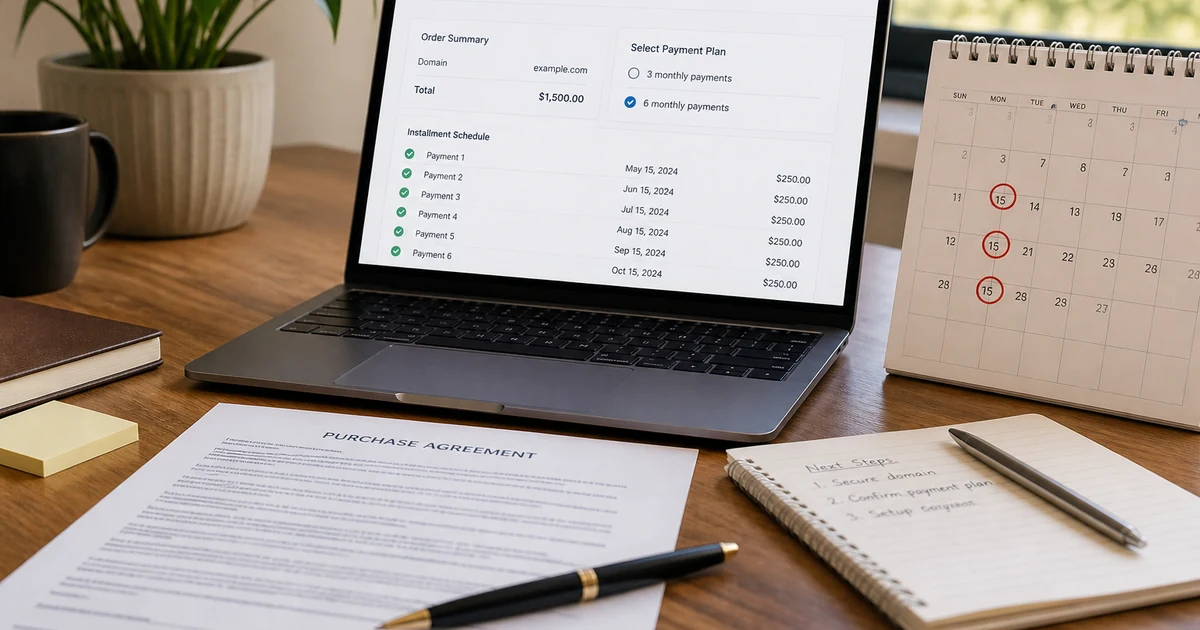
Buyer signs escrow agreement, funds down payment, seller transfers to holding or buyer account per terms, DNS goes live for the product, monthly auto-debits run, title flips at final payment with written confirmation.
Both sides keep copies of every invoice. When investors ask later, you hand them a folder — not a story. That alone is worth the escrow fee.
Marketplace-native BNPL vs custom contracts
Sedo and Afternic templates are faster than attorney-drafted plans for standard deals. Custom contracts make sense above $50,000 or when IP assignments get complex.
Match formality to size. A $7,500 SaaS name doesn't need forty pages. A $75,000 category .com might.
Founders should ask sellers openly: "Do you offer escrow-backed installments?" If the answer is no, that tells you how motivated they are — and how risky the deal is.
Comparing cash vs financed total cost
Run the spreadsheet before you romanticize installments. Cash at $11,000 today versus $12,400 over twelve months only makes sense if preserving $11,000 cash generates more than $1,400 of value in the same year — hires, ads, infra.
Sometimes the answer is yes. Sometimes founders use BNPL to avoid telling the board they spent five figures on a name. Be honest which story is yours.
Document every installment deal in your portfolio ledger the same day you close — future you will thank present you at tax time.
Key Takeaways:
- Domain installment deals help close real buyers with real products — not wishlists.
- Buyers should compare total cost to cash comps and insist on escrow-backed transfer terms.
- Sellers should price risk with meaningful down payments and realistic totals.
- Public sales data may overstate cash velocity when lease-to-own volume is bundled in.
- BNPL is a liquidity tool — pair it with fair pricing, not as a substitute for it.
If you're weighing a structured purchase, start with AutoFlows.app or browse our SaaS names, then read hold rate trends and the FAQ before you sign.
- DN Detector editorial