If you trade premium domains for a living, the Egypt.com lawsuit should sit at the top of your reading list this week - not because geo .coms are suddenly toxic, but because the government's theory of the case is different from anything a UDRP panel usually sees.
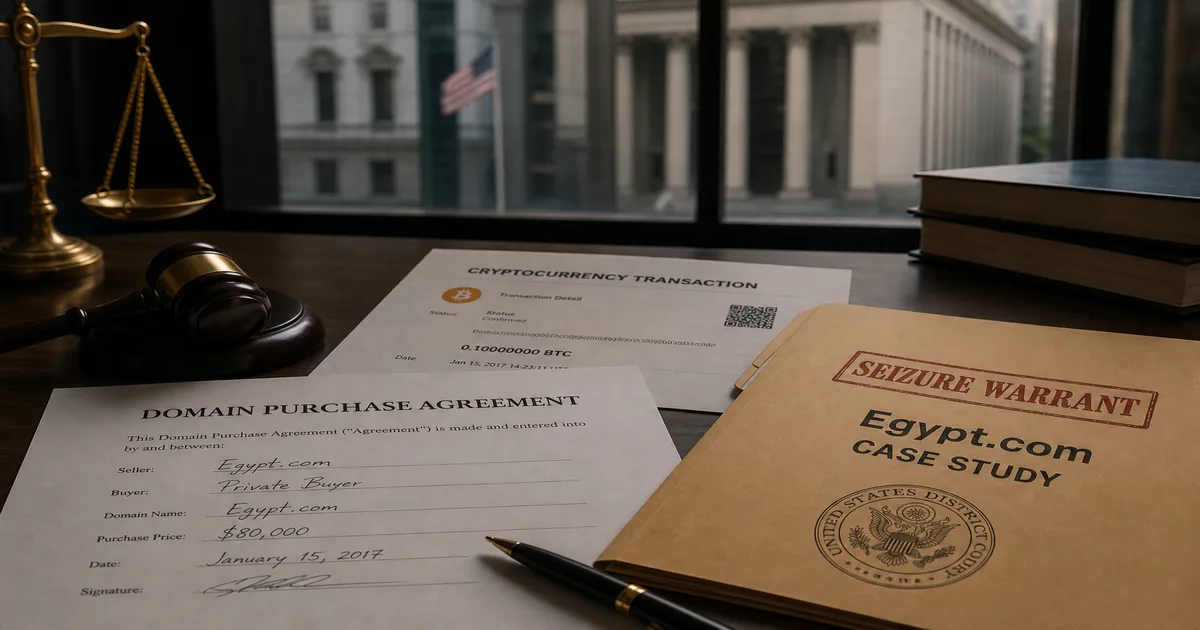
On July 21, 2026, Domain Name Wire reported that the United States filed a civil forfeiture action seeking to seize Egypt.com. Prosecutors allege the domain was purchased for roughly $638,000 using proceeds tied to the darknet marketplace Abacus Market. The name is locked at the registrar while the case moves.
I've underwritten six-figure sales from both sides of the table. Price is only one line on the memo. Title, payment provenance, and registrar status matter just as much - and Egypt.com is the kind of headline that makes sophisticated buyers tighten their process overnight.
What is the Egypt.com lawsuit about?
According to reporting based on a Homeland Security Investigations affidavit, investigators traced cryptocurrency flows connected to alleged darknet drug sales through exchanges and wallets until they intersected with a domain purchase.
The narrative, as summarized by Andrew Allemann at Domain Name Wire, looks roughly like this:
- Funds linked to Abacus Market activity moved through virtual currency channels, including Monero-to-Bitcoin conversions via foreign exchange accounts.
- Bitcoin allegedly landed in wallets investigators associate with a suspected marketplace administrator.
- On September 17, 2024, Egypt.com changed hands for about $638,000 through a U.S. domain brokerage and a U.S. virtual currency exchange.
- Investigators highlight overlapping IP access between exchange accounts held under different identities - a detail that should make every intermediary in the chain nervous.
The government isn't arguing trademark confusion. It's arguing the domain itself is forfeitable property connected to money laundering. That's a different playbook from UDRP - and it can freeze an asset before a final judgment.
A trophy geo .com can be short, famous, and still spend a year locked in a forfeiture fight you'll never see coming if you skip diligence.
Can the U.S. government seize a premium domain name?
Yes - when prosecutors can persuade a court the domain is proceeds of crime or an instrumentality used to launder funds. Registrar cooperation makes enforcement practical. A lock stops transfers, collateralization, and clean exit deals even if marketing copy still calls the name "available."
This is the question I get from founders after every high-profile seizure headline: "Could that happen to a normal buyer?"
Not if you run an ordinary process. But "normal" has a definition in 2026:
- Escrow-backed purchase through a recognized marketplace or broker.
- Clear beneficial ownership - even when WHOIS is private.
- Payment rails that leave auditable records, not improvised crypto hops.
- Confirmation the registrar account is free of holds before you release funds.
Egypt.com is a reminder that six-figure deals attract six-figure scrutiny. Geo generics are scarce and commercially flexible - which is exactly why they clear prices like $638,000. The same scarcity concentrates risk when title is contested.
What should six-figure domain buyers verify before closing?
After Egypt.com, I'd treat this checklist as non-optional for any deal above $50,000 - and honestly, I'd use most of it at $15,000 too.
1) Escrow is the floor, not the ceiling
Use established rails - Sedo, Afternic, Atom, Spaceship, or broker-managed escrow. Escrow protects the handshake between buyer and seller. It does not immunize you from a later government claim if the seller's acquisition funds were illicit. Still, a documented escrow file beats a wire to a stranger.
2) Ask who actually owns the name
WHOIS privacy is standard. Opaque beneficial ownership is not. On large deals, request a simple attestation: who controls the registrar account, who receives proceeds, whether a nominee is involved. Vague answers are a discount - or a walk-away.
3) Treat unusual crypto settlement as a red flag
Crypto can be legitimate. It also creates durable KYC, device, and IP logs at exchanges. If a seller pushes exotic payment paths for a trophy geo, slow down. The Egypt.com reporting leans heavily on exchange records and overlapping access patterns.
4) Confirm lock status before you celebrate
Court orders, compliance holds, and registrar locks can block movement after a handshake. Before final release, verify the name transfers cleanly. A "sold" press release means nothing if the auth code won't move.
5) Archive a defensible paper trail
Save invoices, broker threads, escrow timelines, and transfer confirmations. Future buyers, banks, and counsel may care as much about your process as the string itself.
If you want exposure to high-trust verticals without geo-forfeiture headlines, browse our cybersecurity domain collection or fintech-ready names like DeepBluePay.com - brands built for legitimate products, not darknet receipts.
Why does this case hit brokers and registrars differently?
Intermediaries didn't disappear from the Egypt.com story - brokerage and exchange records are part of the government's narrative. Expect more friction on large crypto-settled purchases: sharper identity questions, faster subpoena response, and less tolerance for "we didn't ask."
That's inconvenient for honest sellers short term. Long term, it protects the aftermarket's reputation. Process quality is becoming part of brand value - right next to length, extension, and commercial fit.
Our acquisition FAQ stresses verified listings and escrow-protected transfers because boring process is protective process. When headlines like Egypt.com circulate, buyers reward sellers who can prove clean title without a detective novel.
Should investors avoid geo .com domains now?
No. Geo .coms remain some of the scarcest inventory on earth. Egypt.com itself proves the category's pricing power. The lesson isn't "never buy geos." It's "never buy geos like they're Pokémon cards."
Underwrite title the way you'd underwrite a building: ownership history, liens, and whether anyone with a badge might disagree with your deed.
For founders who need a credible name this quarter - not a courtroom story next year - start with curated premium inventory where ownership and transfer paths are verified up front. Catch ongoing analysis in our domain news feed when the next seizure headline drops.
I don't enjoy saying "I told you so" after a premium name gets locked. I'd rather say "we used escrow" before you wire six figures.
Ask hard questions. Every time. The domain can be perfect and the title story can still ruin your year.
How is Egypt.com different from a typical UDRP fight?
UDRP panels decide trademark disputes between private parties. Forfeiture cases ask whether the asset itself is tainted proceeds. The remedies differ, the evidence differs, and the speed of registrar locks can differ too.
Corporate counsel knows UDRP. Fewer teams have playbooks for DOJ-adjacent forfeiture headlines. If you're buying trophy inventory, add a counsel review step above your usual threshold - especially when crypto appears anywhere in the payment chain.
Domain Name Wire's reporting is the best public starting point I've seen; pair it with your own escrow documentation and a conservative view of geo scarcity. Egypt.com will resolve in court. Your next six-figure purchase doesn't have to become a sequel.
- DN Detector editorial