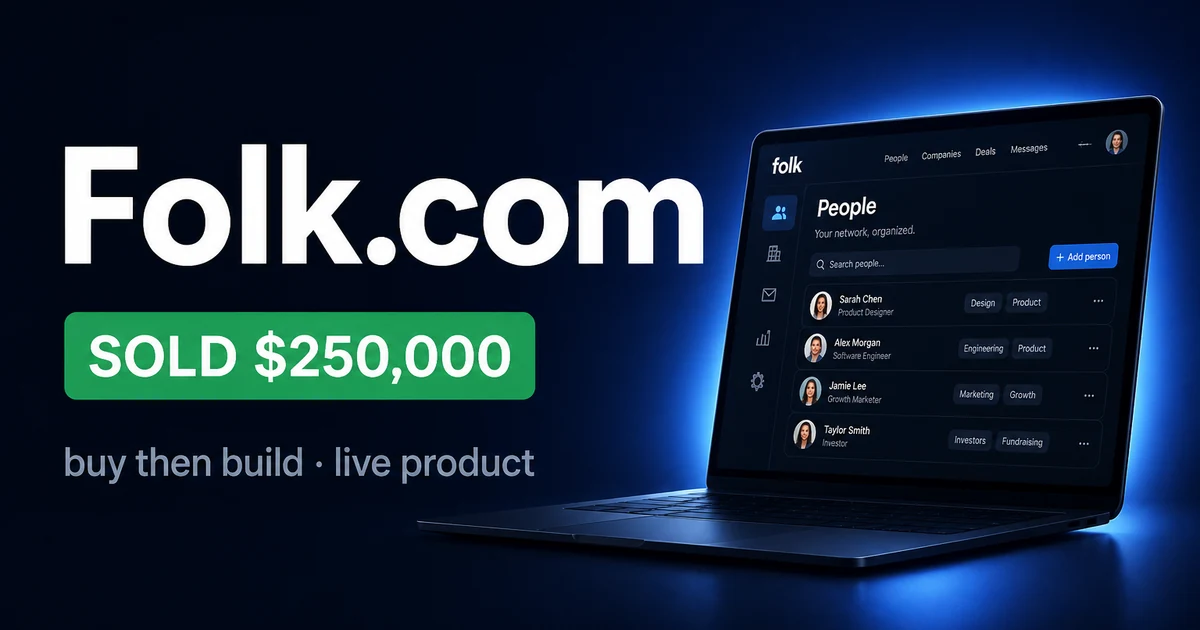
The Folk.com close landed in my inbox on a Tuesday in late July 2026 — $250,000, private, end-user. Not a portfolio flip. Not a broker whisper that never materialized. A messaging and task-management product already live on the name, already shipping features, already collecting users who typed Folk.com and found exactly what they expected. I've tracked premium .com sales for years, and this one stopped me mid-coffee because it confirms a buy then build pattern I've been arguing about since 2024: sometimes the smartest move is buy the domain first, then keep building. If you're still picking a name, the startup domain selection guide pairs well with this sale post.
Folk.com isn't a parked page with a BIN price and a prayer. By the time the deal closed in July–August 2026, Folk was a functioning collaboration tool — inbox-style messaging, shared tasks, the kind of workflow product that lives or dies on daily habit. The buyer didn't acquire a string of letters. They acquired the front door to a category they'd already chosen. Full disclosure: I didn't represent either side on this close. I would have pushed hard for escrow from day one anyway, because end-user deals at this price without verified transfer mechanics are where good intentions go to die.
If you're comparing how August's bigger closes fit into founder planning, the midyear 2026 domain sales breakdown puts Folk.com in context alongside AI.com-tier headlines and quieter product-brand moves. This piece is narrower: what a $250K Folk.com acquisition teaches you if you're building a product-first company and still treating the domain like a year-three problem.
What did the Folk.com sale actually prove?
It proved that end users still pay real money for exact-match .com names when the product already justifies the spend. Folk.com sold for $250,000 in a private transaction reported across industry channels in July 2026. The product was live. Users were active. The domain wasn't speculation — it was infrastructure the team had already bet the company on. When a founder wants a shortcut I walk the boring parts first — fee schedules, renewal math, escrow timing, and the ugly middle where nothing feels exciting — because that middle is where most deals die.
That's the part founders miss when they read sale headlines. They see the number and ask whether Folk.com was "worth it." Wrong question. The right question is whether owning Folk.com was cheaper than running a growth product on Folk.io, GetFolk.com, or a hyphenated workaround while a competitor or squatter priced the .com higher every quarter. My take? For a messaging product where word-of-mouth drives navigation, exact-match .com ownership is distribution you don't have to re-explain on every podcast intro.
I've watched teams spend $400,000 on paid acquisition in a year while refusing a $180,000 domain ask because "we're not ready." Folk.com at $250K is the receipt for the opposite decision — commit to the name when the product proves the category, not when the spreadsheet finally feels comfortable.
Should you buy the domain before the product is finished?
Yes — when direct-type traffic and category clarity matter more than saving cash for six months of runway. No — when you're still pivoting every six weeks and the name might not survive the next board slide.
Folk.com works as a case study because the team didn't wait for Series C polish. They built on the name, proved retention, then paid up to own it cleanly. That's buy then build in the wild: ship on the best available name, treat the .com as a strategic line item, close when the product makes the check size legible to investors. Waiting until "we're big enough" often means paying twice — once in confused traffic, once in a higher ask.
Compare that to the founder who registers a placeholder, raises on it, then discovers the .com owner wants $300K after the TechCrunch write-up. The power flipped. I've seen that movie four times in 2026 alone. Folk.com is the version where the buyer stayed ahead by moving before the headline inflated the price.
Approach When it wins When it hurts Buy .com early, build after Category name, high direct navigation, word-of-mouth product Still searching for product-market fit Build on alt TLD, upgrade later Tight budget, technical audience, short pre-seed runway Consumer brand where .com is assumed Rebrand after traction Placeholder was truly temporary Press, SEO, and email already on old name Folk.com model: product live, then close Usage proves value; escrow-ready deal Seller knows your revenue and raises askHow do you evaluate a buy-then-build domain deal?
Here's the process I run when a founder calls me about a six-figure .com while the product is already in market. Not theory — the same checklist I'd use if Folk.com were my negotiation.
- Quantify direct-type traffic — Pull analytics for navigational visits, branded search, and email link clicks. If more than 15% of new signups type the brand without ads, the .com is doing real work. Our domain tools page has comp-check workflows that help you benchmark whether the ask fits usage, not ego.
- Pull comparable closes on NameBio — NameBio's sales data shows what similar dictionary and short-brand .com names cleared in the last 24 months. Folk.com at $250K sits in the band for short English words with active end-user interest. You need comps before the first counteroffer, not after the seller anchors high.
- Model the rebrand cost honestly — Engineering hours, email migration, support macros, App Store listings, paid campaigns tied to the old domain. I've seen $250K domains look cheap next to a $400K rebrand bill. Spreadsheet it.
- Confirm clean title and escrow path — Escrow.com's domain escrow is boring in the best way: registrar lock, auth code, release on confirmation. Private Folk.com-style deals still need that structure. Our buyer FAQ covers the sticking points I see repeat on six-figure transfers.
- Stress-test investor narrative — Can you explain the purchase as infrastructure, not vanity? Folk.com is an easy story: exact-match .com for a messaging product named Folk. If your story sounds like "we liked the word," keep negotiating or pick a coined name instead.
- Set a walk-away tied to runway — Decide the maximum check as a percentage of remaining cash, not as a standalone number. A $250K domain at nine months runway is a different decision than at twenty-four months. Write the walk-away down before emotions show up.
Does Folk.com change how startups should think about CRM names?
It sharpens the lesson, it doesn't rewrite the category. Folk sits adjacent to CRM and team inbox tools — crowded space, high churn, brutal onboarding. Owning Folk.com doesn't magically improve retention. It removes one friction point: every time someone recommends "Folk," the listener types .com first. Period.
That's different from buying a generic like CRM.com (different price planet entirely). Folk is a brandable dictionary word — short, pronounceable, human. The startup domain selection guide walks through when dictionary words beat coined stems; Folk.com is the dictionary-word case where the product grew into the name instead of the name chasing the product.
My honest caveat: if your product isn't named Folk, this sale isn't permission to overpay for lookalike words. It's permission to take your own exact-match seriously once usage proves the brand sticky. Don't copy the price tag. Copy the sequencing.
Where does Folk.com leave founders in August 2026?
With a clear split. Portfolio investors will note Folk.com alongside other mid-six-figure closes this summer. Product founders should note the sequencing: live product, verified demand, then a $250K check — not the reverse. DNJournal's weekly sales and Domain Name Wire have been tracking the same end-user pattern on short .com brands; Folk.com is the messaging-category data point, not an outlier fairy tale.
If you're still on a placeholder and the product shows Folk-level stickiness, start the conversation before your next press cycle. If you're pre-product, browse coined alternatives in our premium domain marketplace instead of anchoring to a $250K comp that isn't your name. Aifolio.app is the kind of coined identity I'd pick for an AI workflow tool today — category adjacency without a quarter-million price tag on day one.
What would I have done differently on Folk.com?
If I were advising the buyer pre-close, I'd push for two things beyond escrow: a short exclusivity window on marketing claims during transfer, and a written list of subdomains or email aliases included in the sale. End-user deals at $250K sometimes forget ancillary assets — support@folk.com matters as much as the A record. My opinion: treat domain acquisition like a tiny M&A event, not a registrar checkout.
I'd also ask for twelve months of Search Console data if the seller will share it. Navigational traffic is the whole thesis for Folk.com. Without numbers, you're guessing whether $250K buys distribution or vanity. I've seen founders skip this step because asking feels awkward. Awkward beats wrong.
On the seller side, holding Folk.com while the product scaled was rational — the name appreciated with usage. That's the buy-then-build mirror image: build on a lease or licensing deal if you must, but know the seller's BATNA rises with every TechCrunch mention. Folk.com is the case where both sides had real bargaining power, and the close still happened because the product couldn't afford ambiguity forever.
One more messy human detail: team morale. Engineers who shipped for two years on a name want the .com locked before the next fundraise deck goes out. I've watched domain delays become proxy wars for "does leadership commit?" Fixing the name is partly cultural signal. Folk.com at $250K reads as commitment in a way Folk.io never would have.
Buy then build showed up in three buyer chats this week. I wrote it down.
My close: Folk.com won't be the biggest sale of 2026. It might be the most instructive for product founders who still treat the domain like a vanity line item. The team bought the front door they were already asking users to walk through. That's not hype. That's sequencing.