Freenom is back - and the first thing you notice isn't excitement. It's the price tag.
For years, Freenom was the registrar everyone loved to hate: free .tk, .ml, .ga, .cf, and .gq names that powered student projects, sketchy landing pages, and an ocean of phishing sites. Then came the lawsuits, the suspensions, and a long quiet period. In mid-2026, industry chatter on NamePros and Domain Incite confirmed what many suspected: Freenom has returned to the market, but the famous free model is gone.
I've registered throwaway names on free ccTLD tiers. I've also spent hours cleaning malware reports off client portfolios that inherited toxic history. Freenom's comeback is a useful reminder that "free" in domains usually means someone else pays later - often in trust, enforcement, or renewal shock.
What actually changed at Freenom?
The short version: paid registration only, stricter operational posture, and a brand still carrying baggage from the Meta era.
Freenom built its user base on zero-dollar registrations across country-code style extensions that many consumers didn't distinguish from .com. That volume made it one of the largest registrars on earth by domain count - and one of the most abused.
Meta's lawsuit against Freenom alleged the registrar facilitated phishing and cybersquatting at scale, including names that impersonated Facebook, Instagram, and WhatsApp. Registry operators and partners pulled back. Free registrations stopped. Millions of names expired or froze. If you had a project on a free .ml or .tk, you learned the hard way that registrar policy can change faster than your DNS TTL.
Domain Incite's reporting framed the return as a relaunch under commercial terms: users can register again, but not for free. NamePros threads filled with skepticism - not because paid Freenom is inherently bad, but because the user base that made sense for free domains doesn't automatically convert into paying customers with clean intentions.
My read: this is a survival pivot, not a reputation reset. The infrastructure may be back. The trust ledger still has red ink.
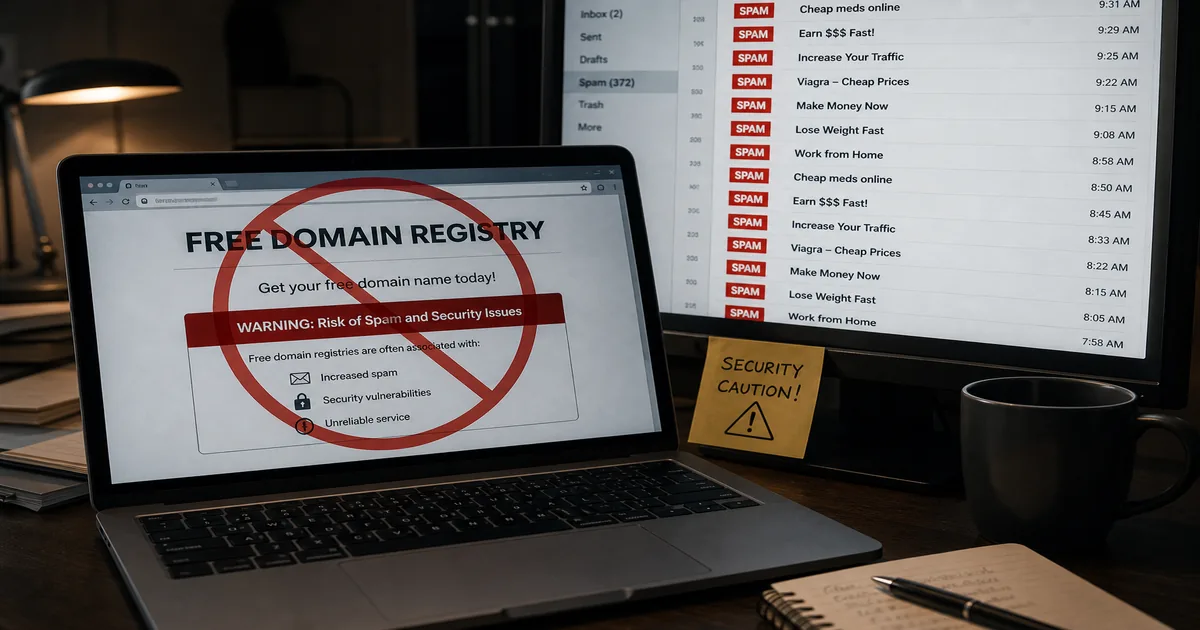
Why did free domains create so much spam?
Free removes friction. Friction is sometimes the only filter you have.
When registration costs nothing, the incentive is to register everything: typo-squats, botnet command domains, one-shot phishing pages, SEO parasites, and disposable affiliate funnels. Abuse teams can't keep pace at that scale. Registries get blamed. Brands sue. That's the cycle Freenom lived inside for years.
Investors sometimes ask whether paid Freenom names are "cheap inventory" now. I'd separate two questions:
- Can you register a name cheaply? Maybe.
- Will email providers, ad networks, browsers, and enterprise buyers treat that namespace as trustworthy? Often no.
I've seen legitimate founders try to save $12 on a domain and lose weeks on deliverability reviews. Saving money on the string isn't savings if Gmail sends your receipts to spam.
Free tiers don't just attract hobbyists. They attract adversaries. Paid tiers without enforcement upgrades just attract adversaries with a small budget.
Should domain investors touch Freenom names in 2026?
My default answer: no, unless you have a very specific use case and you've priced in reputation risk.
Premium domain investing is about scarcity plus trust. Freenom extensions were the opposite - abundant and suspicious. Even with a paid model, historical abuse data doesn't vanish. Security vendors maintain category flags. SEO practitioners remember which TLD clusters were poisoned in 2018, 2020, and 2023.
If you're flipping brandables, you want buyers who can email customers, run ads, and pass a Series A diligence call without explaining their TLD's rap sheet. That's why we curate premium .com and .app inventory with verified ownership - boring extensions, fewer surprises.
Could a paid Freenom name work for a hyperlocal experiment or a disposable campaign microsite? Sure. Should you build equity there? I wouldn't. Not when clean alternatives like Nolu.app exist at price points that won't embarrass you in a pitch deck.
What I'd watch instead of spec registering
- Drop traffic quality - if ex-Freenom names hit expired lists, check blacklist history before you bid.
- Registrar policy changes - first paid year is not the same as stable policy year five.
- Brand enforcement trends - Meta's litigation was a signal that platforms will go upstream to registrars.
- Buyer education - end users still confuse odd ccTLDs with .com; that's a marketing tax you'll pay forever.
What does Freenom's return mean for founders?
Founders love free because runway is real and fear is real. I get it. I also watch companies rebrand after their "free" domain gets suspended or blocked by a major platform.
If you're launching in 2026, treat your domain like infrastructure, not a sticker:
- Buy a name you can renew without thinking about it.
- Prefer extensions with enforced HTTPS and clear category signals (.app for products, .com for authority).
- Keep registrar login secure - 2FA, separate email, no shared agency passwords.
- Document ownership from day one. Future acquirers care.
Our acquisition FAQ walks through escrow-backed transfers for exactly this reason: when money and auth codes move, you want a paper trail that doesn't look like a free-tier experiment.
And if you're hunting bargains, scan expired domain drops with discipline. A slightly used .com with clean history beats a fresh .tk with no history and a inherited reputation problem.
Is the ccTLD free model dead everywhere?
Not universally - but the Freenom story pushed the industry toward paid, verified, and auditable registration across several African and Pacific ccTLD channels that had been exploited as "free globals."
Registries learned that when your namespace is treated as a global free commodity, you lose control of your brand. Country operators don't want their ccTLD synonymous with phishing in Berlin and Bangalore.
For investors, that means the era of registering ten thousand free names and hoping for type-in lottery tickets is fading. Good riddance, honestly. It polluted analytics, poisoned email reputation systems, and made legitimate domain entrepreneurs look guilty by association.
The money now flows to curated aftermarket inventory, brandable compounds on credible extensions, and AI-category names where buyers pay for positioning - not for zero-dollar registration arbitrage.
Full disclosure: I don't miss the days when every security dashboard lit up with another free .tk campaign. If Freenom's paid pivot reduces abuse, that's a win for everyone who sells domains for a living.
Just don't confuse "available again" with "rehabilitated." Your brand deserves better than a bargain bin with a lawsuit hangover.
How do registrars rebuild trust after abuse scandals?
They usually don't do it with press releases. They do it with enforcement budgets, verification steps, and years of clean routing data.
If Freenom's paid relaunch includes stronger KYC, faster suspension for phishing, and transparent abuse reporting, the namespace might slowly rehabilitate in security vendor databases. That's a multi-year project. Investors shouldn't price today's registrations as if the Meta lawsuit never happened.
I watch NamePros threads for a reason - registrars reveal their culture in how they respond to abuse tickets, not how they respond to launch tweets. Domain Incite's coverage of the return is useful context, but the proof is in whether major email providers and ad platforms downgrade risk scores on those extensions six months from now.
Until then, treat Freenom as a case study in free-tier economics, not as inventory for your premium portfolio. The smart money in 2026 is still on credible extensions with enforceable HTTPS, clean history, and buyers who won't flinch when they see the TLD on your cap table.
- DN Detector editorial