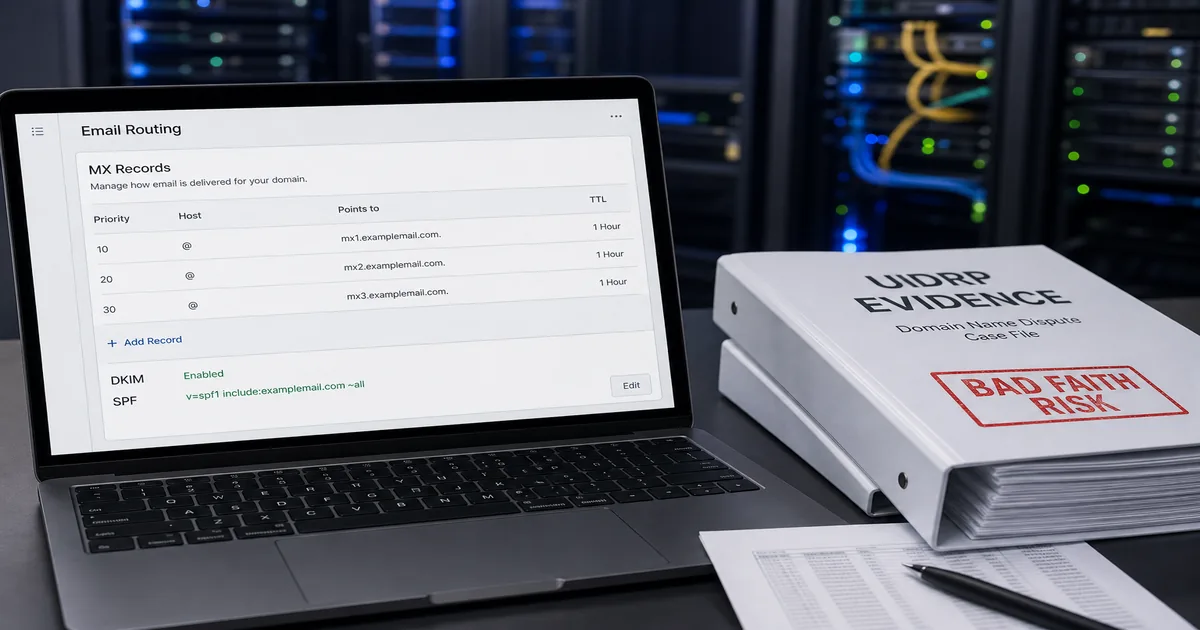
You parked a domain years ago. No site. No ads worth mentioning. You figured passive holding was neutral. Then a UDRP complaint cites your MX records as evidence of bad faith - and the panel agrees.
I started seeing this pattern in 2025. It accelerated in 2026. Panels treat email infrastructure as intent. If your name looks like a brand and your DNS says mail is configured, complainants argue you were preparing phishing or intercepting customer email. Even when you were not. Even when a registrar turned on email forwarding by default.
Empty domains are not empty in the eyes of a trademark lawyer with a forensic DNS export.
Why do MX records show up in UDRP decisions now?
Email abuse is the exhibit panels understand. Phishing volumes keep rising - the Anti-Phishing Working Group publishes quarterly trends that lawyers paste into complaints. When a domain resembles a financial brand, a SaaS login, or a healthcare portal, MX records suggest operational readiness.
Panels already weighed PPC parking as "commercial use." MX is the next lever: "You were not just monetizing confusion - you were positioned to capture messages."
I read a recent decision where the registrant swore the domain was unused. DNS showed MX pointing to a parking provider's mail gateway. Complainant framed it as email capture. Registrant lost. Ugly.
Can default registrar DNS get you in trouble?
Yes. This is the part that should keep passive investors awake.
Some registrars enable email forwarding, catch-all inboxes, or placeholder MX automatically when you buy a name. You never touched DNS. The panel does not care about your story if the export shows mail routing on a typosquat-adjacent string.
My new purchase routine: within 24 hours, audit A, CNAME, TXT, and MX. If I am not actively using email on the name, I remove MX entirely or point only to documented infrastructure I control - usually none on a for-sale holding.
Run the same check on aged portfolio names. Registrars migrate DNS during acquisitions and turn "helpful" features back on.
What should passive domain investors check today?
Treat DNS like WHOIS accuracy - maintenance, not optional.
- MX audit - Export DNS monthly for five-figure holdings. No MX unless you send mail from that domain.
- SPF/DKIM/DMARC - Stray TXT records implying mail auth? Remove if unused.
- Parking provider settings - Disable email products on brand-adjacent names.
- Typosquat distance - If the name is one keystroke from a major brand, your risk budget is different. Price it as legal exposure.
- Landers over raw parking - A clean "domain for sale" page with escrow link reads better than ambiguous PPC on contested strings.
Security-category brandables - like AdNeutral.com for legitimate ad-tech positioning - still need clean DNS stories. Irony: names that sound "technical" attract extra scrutiny from counsel who know what MX means.
How do complainants use DNS in bad-faith arguments?
They submit zone files, historical DNS snapshots, and screenshots of mail client autodiscover attempts. They tie patterns to phishing playbooks. If your domain previously hosted a fake login - even briefly after acquisition - history haunts you.
Search WIPO decisions for "MX" and "phishing." Read three panels. You will stop assuming "I left it blank" means blank.
The ICANN UDRP three-prong test still governs, but evidence bundles got heavier. DNS is cheap to exhibit and expensive to refute if you were careless.
Does removing MX fix everything?
No. It removes one arrow. Development, legitimate sales landers, trademark distance, and clean acquisition history still matter. But removing stray MX is the fastest win I have seen for parked inventory.
Pair DNS hygiene with the defensive documentation we outline in our broader UDRP coverage - registration notes, broker threads, development timestamps.
If you operate in security or privacy niches, browse cybersecurity domains where the brand story is explicit and transferable. Buyers and panels both prefer clarity over cleverness near someone else's mark.
What is my checklist before listing a name for sale?
Before any premium name hits our marketplace criteria or a third-party bin, I verify:
- No MX records unless intentional.
- No catch-all mail at registrar.
- No prior phishing flags in security APIs.
- Landing page states ownership and transfer path.
- WHOIS/RDAP accurate and matching escrow identity.
Our acquisition FAQ explains buyer expectations on verified transfers. Sellers who skip DNS hygiene slow deals when diligence finds messy zones.
What does a clean DNS posture look like on a for-sale holding?
Minimal A record to a branded lander. No MX. SPF only if you send mail - you should not. TXT limited to verification tokens you actively use. CNAME only when your lander host requires it.
I screenshot DNS after every change and date-stamp the file in the domain's dossier. If a complainant alleges mail capture, I can show a timeline proving MX was absent - or was removed before any dispute letter arrived.
When panels cite third-party mail gateways
Parking vendors sometimes route mail through shared infrastructure that also appears in abuse reports. You may never have sent a message, but your MX neighbor did. That is another reason I prefer simple sale landers over full parking stacks on sensitive strings.
Security researchers at APWG track phishing infrastructure patterns panels reference. You do not need to read every report - but know that complainants do.
Should you still buy typosquat-adjacent names?
Only if you price legal risk into the model and you are not configuring mail. I have exited names where the margin looked great until I modeled UDRP defense cost and DNS audit time. Pass is a valid trade.
For legitimate security and ad-tech positioning, prefer invented or descriptive brands in our cybersecurity category over one-character-off corporate strings. Sleep matters.
What if you already lost a name where MX was cited?
Learn and fix the rest of the portfolio. Pull DNS on every holding this week. Remove mail records you do not need. Replace ambiguous parking with a simple lander and marketplace link.
Panels rarely reopen decided cases because you fixed DNS afterward. The fix protects the next name - and it protects buyers who inherit your transfer reputation when you sell clean assets through verified channels.
I run quarterly portfolio audits with a simple rule: if I cannot explain a domain's DNS setup in one sentence, it gets fixed or sold. Passive investing is not absentee ownership - not anymore.
Start with the names that sound most like someone else's trademark. That is where MX surprises hide.
Export your DNS to CSV, filter for MX, and fix anything you cannot justify in writing. Fifteen minutes. Done.
I used to think DNS was the registrar's problem. Now I think of it as part of legal hygiene - same as renewals, same as escrow. Five minutes per domain beats explaining to a panel why you had mail routing on a name that looks like a bank.
- DN Detector editorial