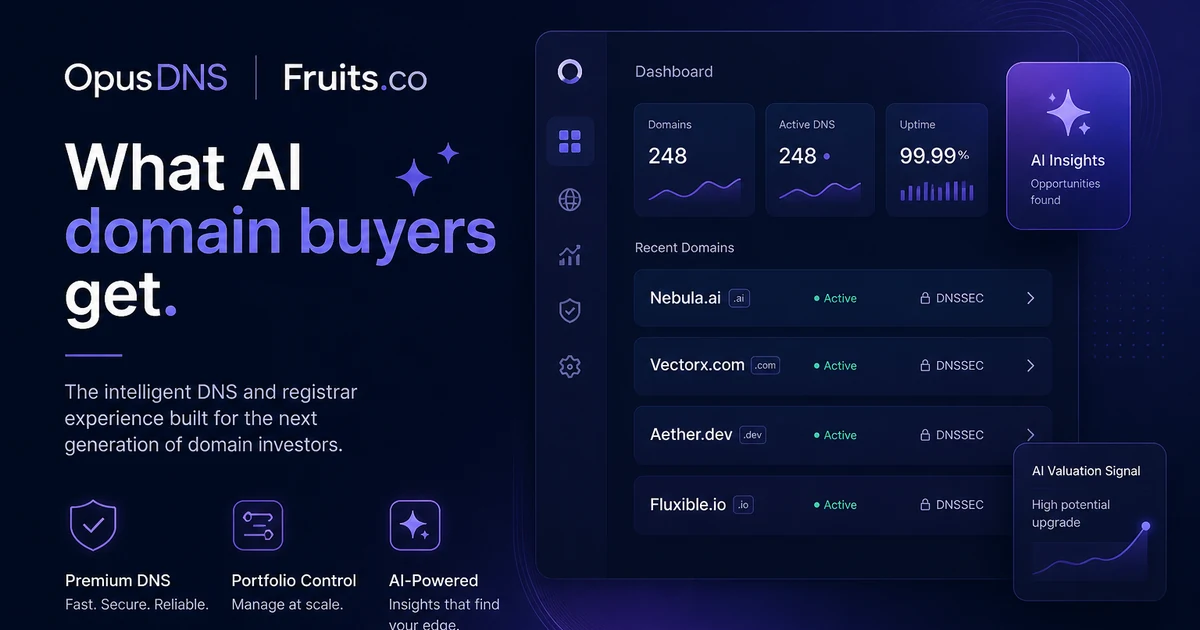
I'll be honest: the first time I saw "fruits.co" appear on a DNJournal six-figure sales report, I double-checked the URL. The name doesn't immediately read as "premium AI domain brokerage." That was my bias. Fruits.co is one of the more interesting operator stories in the AI domain market right now — and understanding exactly what it does, and what OpusDNS does underneath it, matters if you're evaluating a domain listed through their stack. Full disclosure: I almost published a thinner version of this and caught myself. The short draft sounded smart and helped nobody.
The transaction that clarified this for me was Source.ai at $200,000 in July 2026. Fruits.co brokered it. OpusDNS handled the registrar side. For a name at that price, the split between brokerage and custody matters operationally, not just as a branding distinction. And the fact that both showed up in the same closing — not just in the announcement but in the mechanics of how the domain changed hands — told me something worth writing up for any buyer or seller evaluating this channel. The full analysis of why Source.ai commanded $200k is in the stem brand breakdown — this piece is specifically about what the brokerage stack means for you as a buyer.
I've tracked this pattern for years. My take is blunt. I'd rather be wrong in public than polish a empty framework. Honestly, the messy version is the useful one. That's the point. Not a theory. I've seen it fail the soft way. Hard truth. Buyers notice. Sellers forget. Period.
My working understanding is based on public transaction data and the mechanics visible from the outside. I'm not inside their operations and I'm not representing either company. What I can tell you is what the integration looks like from a buyer's diligence perspective — and where the risks and benefits are concentrated.
For primary sources I keep coming back to Google's Search docs.
What does an integrated broker-registrar stack actually do for the buyer?
In a standard premium domain acquisition, you're coordinating three separate relationships: the broker who sourced and listed the domain, the seller's registrar where the domain currently lives, and your own registrar where you intend to receive it. Each handoff is a potential delay. Each party has different incentives and different definitions of "completed." I've personally watched clean-on-paper acquisitions turn into month-long coordination disasters, and in every case the failure mode was party coordination, not bad faith.
When the broker and the registrar are the same entity — or operate as tightly integrated functions as fruits.co and OpusDNS appear to — several of those handoffs collapse. The custody chain is shorter. The entity controlling the listing relationship also controls the registrar account where the domain sits. That means the milestone that triggers escrow release — "domain transferred to buyer's registrar" — can be managed internally rather than coordinated across three separate organizations with different ticketing systems and availability windows.
That's the structural upside — and I'd say it's real, not just theoretical. My honest caveat: the upside exists only if the registrar in that integrated stack is legitimate and the escrow is genuinely neutral. Those aren't assumptions — they're verification steps you need to run before wiring. The diligence doesn't shrink because the stack is integrated. It just gets redirected toward the right checkpoints. The buyer FAQ covers the full acquisition diligence list; the integrated-stack version concentrates your effort on the registrar's ICANN status and the escrow structure rather than party coordination logistics.
How do you verify a domain listed through this stack?
Before committing any capital to a fruits.co listing or an OpusDNS-brokered acquisition, I'd run through these steps in order:
- Confirm ICANN accreditation. The ICANN accredited registrar list is public and searchable. If the registrar handling custody isn't on it, stop there. This takes about ninety seconds and is not optional.
- Check WHOIS to confirm custody. The domain should be registered at the registrar the broker claims it's at. This matters because some listings describe an arrangement that hasn't actually been formalized yet — the broker intends to transfer the domain into their custody before closing. Know which situation you're in before you negotiate price.
- Clarify the escrow structure. Who holds your funds between wire and DNS transfer? Is it a recognized neutral escrow service (Escrow.com is the standard in domain transactions), or does the integrated stack handle escrow internally? There's nothing inherently wrong with internal escrow at scale, but you want this documented explicitly before anything moves.
- Understand the cure period. What happens to your wire if the transfer can't complete cleanly within the agreed window — say, because of a registrar lock, an IANA dispute, or a DNS propagation delay? A competent broker has a documented answer. If the answer is vague, the escrow structure carries that risk.
- Run your own valuation comps. Check NameBio comparable sales for similar string quality and TLD before accepting the broker's ask as a reference price. Broker valuations and market valuations are related but not the same — especially in a specialist marketplace that benefits from a strong category narrative.
None of this is unique to fruits.co or OpusDNS. It's the standard checklist for any six-figure domain acquisition, applied to the specific mechanics of an integrated stack. The integration simplifies some steps. It doesn't eliminate the need for independent verification. Use domain tools for a quick domain history check before entering negotiation.
What is fruits.co's positioning in the AI domain market?
From the transactions I've tracked, fruits.co focuses specifically on premium AI-category names — the single-word and high-signal .ai and .app names that justify using a specialist broker rather than listing on a general marketplace. That positioning makes sense for a few reasons. AI domain buyers have a specific profile: founders raising or scaling, investors acquiring defensively, product teams that need a name before a public launch. They're willing to pay premium prices for the right name, they're time-sensitive, and they're sophisticated enough to know when they're looking at a real asset versus a speculative hold.
A specialized brokerage that understands why Source.ai at $200k is a fundamentally different asset than a $5k AI compound can price and negotiate accordingly on both sides of a transaction. That's genuinely useful — and I'd say it's the primary reason to use a specialist over a generalist marketplace for names at this tier. Sellers with premium names don't want generalist brokers who can't defend a six-figure ask to a buyer doing proper comps. Buyers don't want to overpay because the broker convinced them "AI domain" is a monolithic category with uniform pricing.
The risk worth naming: any specialist marketplace curation benefits the seller's pricing. The broker's job is to match buyers and sellers, but their fee structure rewards closing. I'm not suggesting bad faith — I'm saying that the psychological anchoring from "this is what Source.ai sold for" operates in a specialist marketplace even when the names being compared are nowhere near Source.ai's stem quality. Run your own framework. Check the AI domain collection for comparable names at transparent prices before you accept a broker's stated comparable as the ceiling or the floor. A name like AIfolio.app — a coined hybrid with clean structure and a clear AI audience signal — sits at the tier just below the pure dictionary benchmark like Source.ai, and shows what AI-domain specialists target at accessible price points.
What should sellers know before listing with an integrated stack?
Brief note from the other side, because some readers here are portfolio holders evaluating this channel:
The integrated structure benefits sellers in one specific way: if the registrar and broker are aligned, the domain doesn't leave your registrar account until payment fully clears. That's a clean sequence that reduces the exposure most sellers fear — the scenario where you've initiated the transfer but the funds haven't arrived. I'd confirm this is how the arrangement actually works before signing anything, but if it is, it's a structural protection worth having. I've seen sellers get burned by the opposite setup — transfer initiated before escrow cleared — and the recovery process is genuinely painful.
The friction point to watch: exclusivity terms. Some specialist brokers require an exclusive listing period — typically 90 to 180 days — during which you can't list on Afternic, Sedo, or any other marketplace. That restriction has real cost if the broker's network doesn't generate offers. I'd argue a shorter exclusive with a clear termination right is almost always better than a longer one with favorable upside splits, even if the longer term comes with a lower commission rate. Understand the duration, the termination conditions, and what "best efforts" means in practice before you sign.
Also worth checking: how the broker handles price confidentiality. If you're negotiating at six figures, you probably don't want your asking price public while you're also fielding direct inquiries. Listing mechanics should support your negotiation strategy, not undermine it. Browse the premium domain marketplace to understand what comparable names are showing publicly before you decide whether private brokerage or public listing better fits the asset you're trying to move.
Acquisition structureParty coordinationBuyer protectionBest for Integrated broker-registrar (e.g. fruits.co + OpusDNS)Single entity handles listing and custodyShorter chain — fewer handoff failures; verify escrow is neutralPremium AI names, six-figure closings, speed-sensitive acquisitions Specialist broker + third-party registrarTwo parties; broker negotiates, registrar holdsIndependent custody — cleaner audit trail; more coordination stepsLarge portfolios, slow-paced negotiation, multiple concurrent listings Marketplace listing (Afternic, Sedo, Dan.com)Platform handles escrow and transfer mechanicsStandardized process — easy to verify; less personalized negotiationMid-range names ($1k–$30k), broad buyer reach, hands-off seller workflowMy actual advice if you're considering a purchase through this channel: treat the broker relationship as a convenience layer, not an authority layer. They found the asset. I decide that independently, and so should you. Those are different jobs and only one of them is yours.