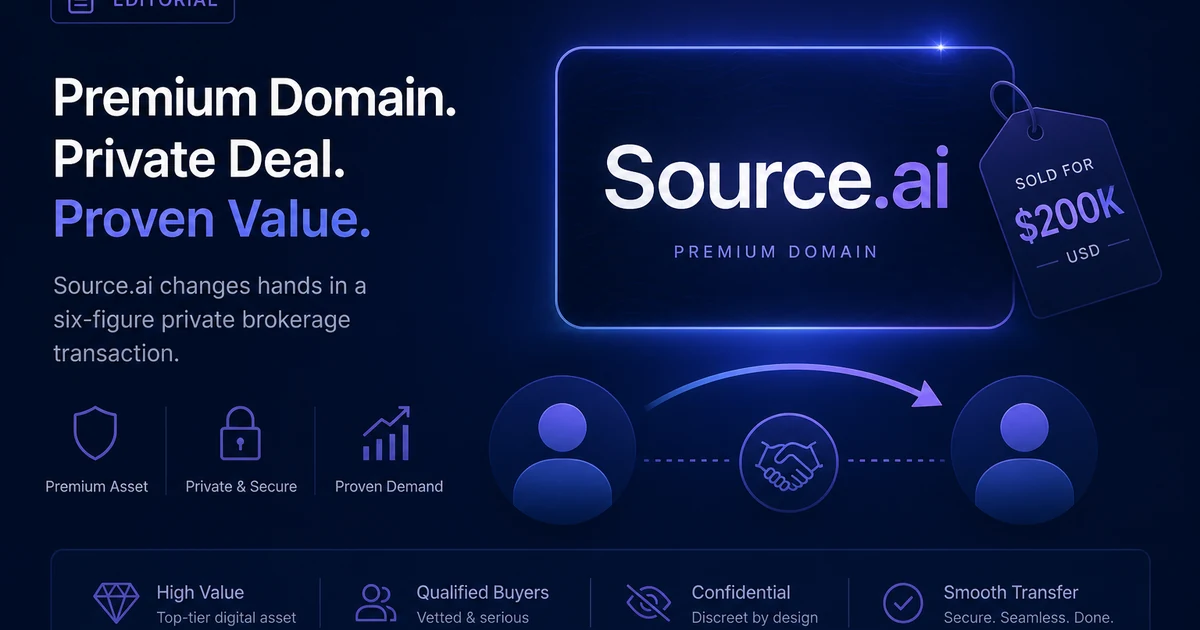
I'll say it plain: private brokerage is the thread I keep coming back to. private brokerage shows up in every deal conversation I have about this. If you only remember one phrase from this piece, make it private brokerage. I saw the number on a Tuesday morning and stopped scrolling. Source.ai, $200,000, closed through fruits.co brokerage on an OpusDNS referral — announced in DNJournal's July 29 lowdown and instantly picked up across every domain investing forum worth reading. Not an Afternic sale. Not a public auction where every competitor could watch the bid ladder and time a counter. A private deal that the market never saw coming, structured exactly the way the best names should be sold.
Full disclosure: I almost wrote off fruits.co as a boutique play with limited reach. I've been tracking premium .ai sales since the extension started appearing in Series A decks rather than just developer side projects, and I assumed the serious volume would stay on Afternic and Sedo. The Source.ai close changed my thinking. Not because $200K is routine — it isn't — but because the deal structure reveals something about where the premium end of the .ai market is actually clearing in 2026. If you're holding a short, strategic .ai name, that structure is worth understanding before you decide where to list it.
I've tracked this pattern for years. My take is blunt. I'd rather be wrong in public than polish a empty framework. Honestly, the messy version is the useful one. That's the point. Not a theory. I've seen it fail the soft way. Hard truth. Buyers notice. Sellers forget. Period.
OpusDNS acquired fruits.co earlier this year. The founders — Hakan Ali and Robbie Birkner — built a model around pre-qualified buyers and private inventory. Fabian Heuschele, who built fruits.co, spent years developing a simple thesis: the best names rarely hit public marketplaces at their real value. They get sold quietly, at prices that reflect what the asset is worth to the right company, not what a bidding floor produces. Browse our AI domain category to see the names we're watching in the same tier — though most of them will end up in different channels than this one. And before you read further, check our midyear 2026 .ai sales roundup for context on where Source.ai ranks year-to-date. It sits at the top of a very competitive list.
For primary sources I keep coming back to Google's Search docs.
Why did Source.ai close at $200,000?
One word. Dictionary noun. Cross-industry relevance. Zero trademark landmines. "Source" reads equally well across AI pipelines, data infrastructure, open-source tooling, and enterprise software. A CTO can approve it in a five-minute review because there's nothing to explain. It doesn't require a slide about what the company means by it. The name is the meaning. That simplicity is the premium.
That combination is genuinely rare. I've checked NameBio weekly for two years and names that hit all four criteria simultaneously on .ai are scarce at any price. Most .ai names trading in 2026 land below $5K — thousands of them move for under $500. Source.ai is several standard deviations from the median, not a benchmark for your portfolio. The buyer at $200K was paying for strategic fit, not for the extension alone. If your .ai name requires explanation, it's not a Source.ai analog. That's not criticism. It's inventory management.
The private brokerage path is what made the number achievable. A public listing anchors the conversation at whatever BIN you set. It invites lowball offers from buyers who aren't the right fit. It signals urgency to anyone watching your expiration date. Private brokerage with warm buyer relationships removes all of that friction. The seller didn't need the chaos of a public auction. The buyer — a funded team treating this as infrastructure spend, not domain speculation — didn't want a bidding war that exposed their acquisition strategy. Both parties benefited from the channel choice.
My take? The deal isn't just about Source.ai. It's about what happens when a broker's existing relationships and a seller's willingness to work privately combine with a name that genuinely deserves that treatment. All three conditions have to be true simultaneously. Miss any one and the math changes.
Is the fruits.co / OpusDNS model right for my .ai name?
Probably not. I'll say that directly so the rest of this piece is useful rather than aspirational.
The brokerage model that closed Source.ai targets names with attributable, specific strategic value to a small pool of well-funded buyers. If you can name the three companies most likely to own your domain and explain exactly why each benefits from it, you're in the right zone. If you'd describe your .ai name as "solid" or "brandable" or "has good energy" — list it publicly first. Marketplace default, broker exception.
I've spoken to investors who spent six months in broker relationships for mid-market .ai names and ended up closing at prices they could have hit on Afternic in six weeks. Not because the broker was bad. Because the name didn't have the concentrated buyer pool that makes brokerage worth the commission and the exclusivity period. The Source.ai close is a data point. Treat it like one. For names in our portfolio with specific strategic fit, we frame the value clearly for the right buyer — take a look at the AiFolio.app listing as an example of how we position a name for a specific buyer profile without relying on a private broker arrangement.
The other factor worth understanding: OpusDNS's acquisition of fruits.co signals where they see the .ai market going. Tech and AI extensions. Enterprise software buyers. Companies treating domain acquisition as a naming budget line item, not speculative expense. That's a specific buyer profile. If your name doesn't fit that profile, their network may not reach your buyer. A broker is only as valuable as the buyers they can actually call.
What the two-tier .ai market looks like in 2026
I've been watching this split develop since Q4 2025. On one side: commodity .ai extensions trading publicly at sub-$5K, often sub-$1K. Volume is real. Speed is real. Discovery happens through registrar searches and Afternic's distribution network. This tier is healthy and works exactly as a marketplace should.
On the other side: category-defining short .ai names that don't appear in public marketplaces at real prices. They're either held in private portfolios waiting for the right buyer, or they clear through brokerage relationships that never get recorded in NameBio at all. The off-market nature of the second tier is what makes it hard to track. You only see it when a deal gets announced — like Source.ai did on July 29.
The practical implication for investors: your comp work on NameBio captures the public marketplace tier accurately. It undercounts the private tier by definition. If you're pricing a short, strategic .ai name based purely on NameBio comps, you might be anchoring below what a private channel could achieve. And if you're pricing based on the Source.ai headline without having a genuine Source.ai-caliber name, you're anchoring above. The Bot.ai sale breakdown from earlier this year covered similar dynamics — worth reading alongside this piece for the full picture on what separates headline sales from the market median.
Where does your .ai name actually belong?
Three questions. They give me a cleaner answer than any channel comparison framework I've tried.
First: can you name specific companies who should own this name — and how many? One to three? Private brokerage might earn its fee. Ten to fifty? Public marketplace. You want discovery at scale, not targeted outreach to a handful of buyers.
Second: does your name require a warm conversation to explain its value? Generic brandables sell at first sight on a well-priced lander. Strategic names with less obvious fit sometimes need a broker to frame the pitch for the specific buyer. That framing is what justifies the commission — not the name's quality alone.
Third: can you absorb a six-month exclusivity period if the broker relationship doesn't produce a close? The opportunity cost is real. A name that would have sold on Afternic in four months at $15K loses money in a six-month exclusive brokerage arrangement that produces $18K at a 20% commission. Do the math before you sign. Our acquisition FAQ has a plain breakdown of brokerage commission structures and what to watch for in exclusivity clauses. And our domain tools page has resources for checking category-level comp data before you set your expectations on either channel.
ChannelBest fitTypical feeWatch out for Private brokerage (e.g. fruits.co / OpusDNS)One-word strategic .ai, small identifiable buyer pool10–20% commission6-month exclusivity lock-in, thin buyer network Afternic / Sedo public listingSolid brandables, wide .ai buyer pool, keyword names15–20% marketplace feePrice anchoring, public visibility signals urgency Direct seller outreachOne obvious ideal buyer you can identify and contactNo commissionTime-intensive, no intermediary protection or escrow Public auction platformHigh-demand names where price discovery is the goalVaries, often 15%+Floor bids, bidder chilling, no soft landingWhat happens next in the .ai private sale market
The Source.ai announcement will produce a predictable wave. Investors who were sitting on short .ai names at $25K will revise to $200K overnight. Brokers will receive inquiry spikes from sellers who think they have the next Source.ai. Most of those conversations won't close, because most of those names aren't Source.ai analogs. I've seen this pattern play out after every headline sale in every extension category. The number gets cited; the profile doesn't.
But the underlying dynamic is real. The OpusDNS / fruits.co infrastructure now has a marquee case study. That attracts more serious sellers, which attracts more serious buyers. The private brokerage tier of the .ai market just got more legitimate. That's actually good for investors who have genuine strategic assets — the channel becomes more credible when it closes landmark deals publicly. And it's good for buyers who need a category-defining name without triggering a bidding war.
I'll be watching the next three quarters of .ai activity more carefully than usual. If the private brokerage channel starts producing consistent five-to-six-figure closes without public disclosure, the NameBio data becomes even less representative of actual market prices in the top tier. Track new closes through DNJournal announcements — that's where private deals get announced when sellers choose to disclose. Some don't. The ones that don't are the deals you never hear about, which means the two-tier gap is wider than any public data set shows. Browse our premium domain listings to see where we're positioning .ai inventory in that context.
Key Takeaways
- Source.ai's $200K close through fruits.co and OpusDNS confirms private brokerage works — specifically for short, one-word strategic names with a small, identifiable buyer pool, not as a general channel strategy.
- The .ai market is splitting into two tiers: commodity names trading publicly under $5K, and category-defining names clearing off-market where NameBio never sees them.
- Private brokerage earns its commission when you can name the right buyer before the conversation starts. It doesn't earn it for solid brandables — those belong on Afternic with a competitive BIN.
- Don't price your portfolio off the Source.ai headline unless your name genuinely matches the profile: one word, dictionary noun, zero trademark conflict, cross-industry utility.
- The private .ai brokerage tier is maturing post-Source.ai. More serious sellers, more credible channel, more deals that never hit public data. That's the market you're actually in.
The Source.ai story doesn't end with the sale. It's a proof point that reshapes how serious .ai inventory should be positioned. If you're holding names in that category, now is a good time to audit your channel strategy. Public is default. Private is earned.