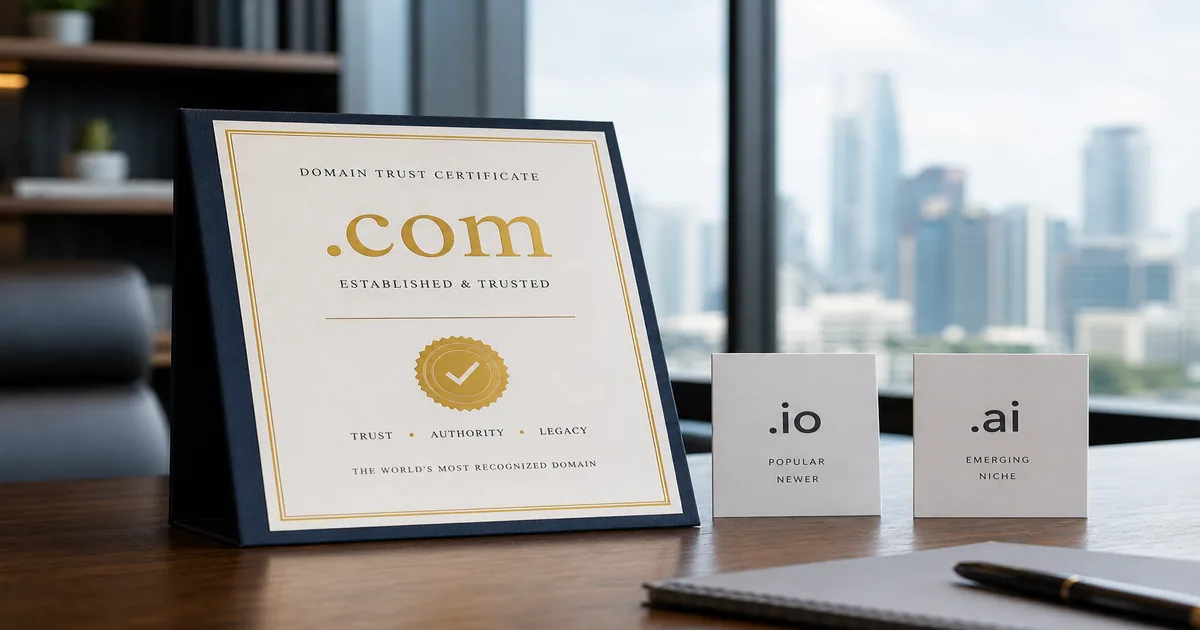
Every year someone declares .com is dead. Every year the biggest checks still clear on .com. I watched a fintech founder pass on a perfect .app at fair price because their lead investor "wanted the dot-com confidence." Irrational? Maybe. Real? Absolutely.
Brandable .com domains still win in 2026 for consumer and enterprise brands alike - not because alternatives failed, but because .com remains the default mental shortcut for trust, email deliverability, and "this company has its act together." Here's when the premium is worth it, and when it's nostalgia talking.
Why does .com still signal trust to consumers?
Twenty-five years of habit. Your parents type .com. Your customers' IT departments whitelist .com more easily. Phishing education literally warns about weird extensions - which accidentally punishes legitimate new TLDs while reinforcing .com as "normal."
Consumer apps with TV or podcast ads still see direct-type traffic skew .com even when the product lives on .app. Some founders buy the .com just to redirect - expensive, but cheaper than leaking confused users.
Verisign's industry data shows .com still commanding the overwhelming share of registered domains and high-value sales headlines. The press covers Voice.com, not Voice.app - even when both exist.
When should enterprise buyers pay the .com premium?
When procurement, security review, or global email deliverability sits in your sales cycle. Enterprise buyers forward links internally. A unfamiliar TLD triggers "is this phishing?" threads. A clean .com brandable usually doesn't.
Pay the premium when the domain is your company name - not a campaign microsite. Pay when you raise institutional money and diligence asks about defensive assets. Pay when your outbound SDRs live in email and the domain is the from-address trust layer.
Skip the premium when you're niche devtools selling to engineers who live on GitHub and couldn't care less about TLD theology - until they do, at Series C. Timing matters.
.com is a trust shortcut. Enterprise still loves shortcuts.
What makes a brandable .com worth five figures?
Length, phonetics, versatility, and clean history. The best brandables work across categories - audio, identity, finance, health - without locking you into one keyword niche.
AudioNames.com is the shape I mean: two clear words, instant mental image, broad enough to grow with the product. Names like that trade at premiums because they're rare and reusable - the opposite of a exact-match keyword domain that dies when Google updates.
Comparable sales on NameBio still show two-word .com brandables clearing strong five-figure ranges when both words carry positive connotations and the radio test passes.
Are .app and .io catching up - or stuck in second place?
They're catching up in product-led SaaS and AI - especially where the buyer is technical. They're stuck in second place anywhere trust is decided by non-technical stakeholders - boards, insurers, legacy enterprise IT.
Smart founders hedge: build on .app, secure .com when cash allows, redirect confusion traffic. Dumb founders fight holy wars on Twitter instead of shipping.
Our premium listings include both - SaaS .app names for speed, AudioNames.com-style .com brandables for maximum trust ceiling. Pick the asset that matches your buyer persona, not your personal TLD religion.
How do I decide if a .com premium is rational?
Run the math like an adult. If the domain costs $25K and you expect $2M ARR within three years, it's a rounding error with marketing upside. If the domain costs $25K and you're pre-revenue with six months runway, it's a vanity suicide unless the name is the product story.
Ask: will this name appear on contracts, invoices, press releases, and support emails? The more surfaces, the more .com pays rent.
Use escrow for acquisition - always. Our acquisition FAQ walks through verified transfers. A premium .com with messy ownership is not a bargain. It's a lawsuit waiting for a calendar invite.
Read domain market insights for comp context before you offer.
Does email still make .com the default corporate choice?
For many companies, yes. Your domain is your email domain - and email is still how deals, support, and invoices move. IT teams maintain allowlists and security policies trained on decades of .com corporate traffic.
I've watched startups on trendy extensions get flagged by overzealous filters at Fortune 500 partners. Not fair. Fixable with time and reputation. But the .com upgrade removes a meeting you didn't want anyway.
Consumer brands feel this on password-reset emails and billing receipts. Users trust the sender when the domain matches what they typed into Google. Mismatch breeds phishing anxiety - even when you're legitimate.
What about defensive registration and portfolio strategy?
If you own the .com brandable, consider whether defensive buys (.net, obvious typos) are worth renewals. For most early-stage teams, no - focus budget on the primary asset and product. For funded companies with impersonation risk, selective defensive regs make sense.
Domain investors approach differently: buy brandable .com inventory with broad resale appeal - two-word compounds, positive connotations, no niche lock-in. AudioNames.com fits that mold; so do names in our premium catalog built for multiple buyer personas.
Don't confuse defensive regs with portfolio hoarding. A hundred mediocre .coms isn't a strategy. A dozen excellent brandables with clear stories is.
When a .com premium is NOT worth it
If you're building a developer tool sold through GitHub stars and Discord, engineer buyers may respect a sharp .app more than a mediocre .com. If your market is entirely mobile-native Gen Z, extension orthodoxy matters less than TikTok handle alignment. If the .com is $80K and the .app is $8K and you're pre-seed, ship on .app.
Brandable .com still wins the trust ceiling game - not every single go-to-market motion. Match spend to stage.
I'll keep buying and listing strong .app names - they're perfect for product stories. But when a founder asks me what closes enterprise pilots faster, I still point at a clean two-word .com on the conference slide. The market hasn't finished unlearning thirty years of habit yet.
How do brandable .coms perform in resale vs development?
Resale buyers want versatility - names that work for multiple industries without a rebrand. Developers want fit - a name that matches their specific product story. The best brandable .coms serve both: broad enough to resell, specific enough to inspire.
We price accordingly on DN Detector. A name like AudioNames.com attracts audio startups, identity platforms, and creative tools - wide buyer pool, faster liquidity. That's the investor case for .com brandables in one sentence.
Next time someone tells you .com is dead, ask what extension their lawyer prefers on a term sheet. You'll get a honest answer fast.
I own .app names I love. I still recommend .com when the buyer can afford it - because the market's trust reflex hasn't caught up to our TLD preferences. Until it does, brandable .com domains keep winning.
- DN Detector editorial