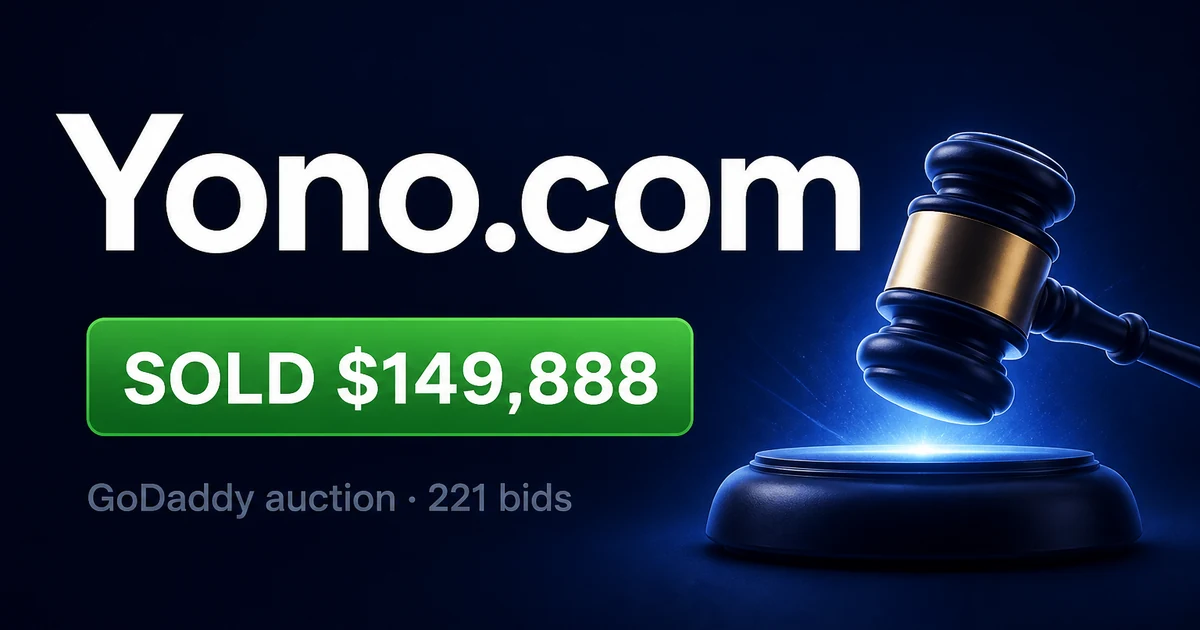
Two hundred twenty-one bids on yono com is the part I still cannot stop replaying. Yono.com closed at $149,888 in a GoDaddy auction on 13 August 2026 — not a quiet BIN, not a broker whisper, a public fight with a very specific final number. Full disclosure: I almost ignored auction recaps this summer because handreg ROI screenshots were louder. Then I saw the bid count and remembered why auction depth still matters.
I verified the sale band against day reporting habits I trust on NameBio and kept DNJournal open for weekly texture. For earlier 2026 liquidity context, our midyear 2026 domain sales piece still frames how short brandables were clearing. Peer contrast in the same August pack: Beel.com near $88,838 is a 4L story; Yono.com is a four-letter brandable auction with crowd heat.
My confession: I used to treat "about 221 bids" as hype language. Depth like that is not hype. It is evidence that multiple parties saw optionality in the same short string at the same time.
What the Yono.com auction actually showed
Yono.com is a clean four-letter .com with soft vowels and easy global pronunciation. It can wear fintech, consumer app, creator brand, or regional product without collapsing into a forced acronym story. GoDaddy's auction format turned that optionality into a price discovery machine. $149,888 is oddly precise — I trust precision more than round fantasy.
I've watched thin auctions print misleading "comps" when two friends poke each other. ~221 bids is not thin. Thin is eight bids and a victory lap on Twitter. Depth changes how I underwrite the clear: more independent interest, less chance the number is a private joke.
Is every four-letter .com now "worth" $150K? Obviously not. Pronounceability, cultural neutrality, and lack of toxic meanings still decide everything. Yono clears the speak test in most rooms I've tried. Many 4L strings do not.
Did ~221 bids make $149,888 a reliable market signal?
More reliable than a two-bidder close — and still not a floor for your weaker 4L sheet. Bid depth improves confidence in demand. It does not clone demand onto unrelated strings.
My honest line: auction psychology can stretch a final price when two end-users refuse to lose. That stretch is real money for the seller and a warning for buyers who confuse adrenaline with appraisal. If you were underbidder number 200, congratulations on participating. If you are pricing your portfolio off the winner's adrenaline, slow down.
I still keep marketplace process tabs open on Atom.com and escrow references handy via Escrow.com because post-auction transfer discipline is where good stories go bad. Winning the bid is step one. Clean control of the name is the product.
MetricYono.com (13 Aug 2026)Why it matters Sale price$149,888Public GoDaddy auction clear Bid depth~221 bids (DSAD / auction recap)Crowd interest, not a two-party blip Pattern4L brandable .comSpeakable, flexible end-user lanes VenueGoDaddy AuctionsPrice discovery with public heat CompareBeel.com ~$88,838 (Atom)Different 4L paths, same monthHow should investors read a deep GoDaddy 4L auction?
Read depth as demand evidence, read the string quality as the real asset, and refuse to export the hammer price onto junk inventory.
- Confirm price, date, and venue — Yono.com, $149,888, GoDaddy, 13 August 2026. Quote sources, not screenshots alone.
- Weight bid count honestly — ~221 bids signals breadth. Still ask whether late bids were serious end-users or domainer ping-pong.
- Say the name in three accents — If pronunciation collapses outside your city, the global buyer pool shrinks.
- Map end-user categories — App brand, fintech coinage, consumer CPG, regional services. Empty maps mean speculation theater.
- Separate auction heat from BIN reality — A lander without traffic will not automatically inherit this hammer.
- Plan transfer and escrow before you bid next time — Our buyer FAQ exists because people win names and then improvise custody.
What I'd do differently after watching Yono.com clear
I'd spend more time on speakable 4L quality and less time on consonant soup that only looks "premium" in a spreadsheet font. I'd also budget for auction adrenaline — meaning I'd set a walk-away number before the UI starts flashing.
For comps workflows I trust, I use domain tools. For live brandables when you are not hunting a six-figure auction war, browse premium domains. If your product needs a coined tech brand rather than a pure 4L root, Aifolio.app sits in that lane.
Honestly, the $149,888 figure is less interesting to me than the behavior behind it. Crowds do not throw 200+ bids at names they find ugly. Ugliness is subjective — market rejection is not. Yono got accepted in public, repeatedly, in a single event.
Where deep auctions sit next to Atom retail and broker wires
Auctions discover price under time pressure. Atom retail and brokers often discover price under relationship pressure. Both can be "true." Neither should be copy-pasted blindly. I've seen sellers quote Yono.com into a negotiation for a weaker 4L and watch the buyer leave. I've also seen buyers lowball a strong 4L because they only study expired junk clears. Both mistakes are avoidable.
Four-letter .coms remain a crowded philosophy. Liquidity exists. Quality is uneven. The market pays for names that feel like brands on first hearing. It punishes names that feel like license plates. Yono lands on the brand side of that line for me. Your ear might differ — test with people outside the industry before you bid like a believer.
Same-month compares help. Beel.com's Atom story is a hold-and-exit narrative with a rebrand angle. Yono.com is a public auction heat narrative. Studying only one narrative makes you a specialist in half the market. Specialists miss wires that do not look like their favorite chart.
I also watch aftermarket for "Yono-adjacent" inventory — longer variants, other vowels, creative spellings. Most of it is noise. Premium accrued to the clean .com in a deep auction. Close-enough strategies usually become expensive hobbies.
If you are a founder who lost this auction, do not spiral into a worse emergency purchase the same night. Adrenaline shopping is how companies end up on awkward spellings they hate six months later. Sleep. Rebuild a shortlist. Buy the next name that still passes the speak test without needing 221 strangers to validate your taste.
If you are an investor who won names like this before, document your process. What filters put Yono-class strings on your watchlist? What filters kept junk off? Process compounds. Screenshots do not.
I will keep writing about yono com style auction clears when bid depth is part of the public story. Depth is a teaching tool. Price alone is a trophy. Teaching tools build better portfolios. Trophies build better Twitter threads. I know which one I need more.
One practical escrow note before the takeaways: high five and low six auction wins attract phishing and fake transfer help. Use official channels. Verify registrar messages. Do not freelance custody because someone in a chat "knows a guy." The guy is often the problem.
GoDaddy auction culture will keep minting numbers that look weirdly specific — $149,888 is peak example. Specificity does not make a number sacred. It makes it checkable. Check it. Context it. Then decide whether your next bid belongs in that neighborhood at all.
Why yono com style 4L auctions punish spreadsheet-only investors
Spreadsheets love length and pattern codes. Auctions love mouths and wallets. Yono.com won because people could say it and imagine shipping on it. I have watched beautiful regex portfolios die in auction rooms because nobody wanted to put those strings on a business card. If your acquisition model never includes a spoken test, you are optimizing for a market that does not pay you.
I also separate "liquidity event" from "repeatable edge." A deep GoDaddy auction with ~221 bids is a liquidity event with unusual heat. Your edge is not predicting the exact hammer. Your edge is recognizing which 4L strings could attract that heat before the UI fills with fire emojis. Recognition work happens on quiet Tuesdays, not during the final sixty seconds.
Budgeting for auctions needs two numbers: the walk-away bid and the post-win transfer cost in time. People remember the first and forget the second. Auth codes, registrar locks, escrow timelines, and phishing risk all show up after the dopamine hit. If you cannot staff that process, do not play in the $149,888 neighborhood. Play smaller or play through brokers who already operationalize custody.
For founders who keep asking whether they should enter these auctions: only if the name is the brand you will still want in year five. Auction pressure makes temporary infatuation feel like destiny. Destiny is rare. Most late bids are fear of losing to a stranger. Fear is not a brand strategy. Write the product sentence first. If yono com does not appear naturally in that sentence, leave the auction.
Investors should also track how often deep auctions appear for truly clean 4Ls versus for compromised strings with trademark baggage. Heat on a clean string teaches one lesson. Heat on a contested string teaches another — usually about legal budgets. I am not your counsel. I am telling you to ask the question before you celebrate a hammer.
I will keep a private note titled yono com auction depth next to other 2026 4L clears so I do not remember only the dollar figure. Dollar figures without depth and without speakability notes turn into folk tales. Folk tales make the next generation of investors overpay for license-plate .coms while muttering about "the 4L market." There is no single 4L market. There are mouths, meanings, and moments. Yono.com had all three on 13 August 2026.
My close: study the bid count, respect the string quality, and keep your walk-away number written down before the auction clock starts lying to your brain.