Smoothie.com just opened a door most domain investors spent twenty years joking about. On July 1, 2026, Michael and David Castello — the Castello Cities Internet Network founders behind category names like Whisky.com — put a slice of Smoothie.com onto Doma's fractional ownership rails. Not a blog brainstorm. Not a white paper. A live category-defining .com with a stated $3.5 million asset value and tokens representing a minority stake.
I've been hearing "fractional domain ownership" pitched since the mid-2000s. Usually it died in legal fog, custody questions, or a platform nobody trusted with a seven-figure name. This time the sellers are Domain Name Hall of Fame types, not anonymous wallet farms. That changes the temperature in the room. I've got opinions. Some of them are uncomfortable.
Full disclosure: I have not bought $SMOOTHIE tokens. I'm writing this as someone who buys and sells whole domains through escrow, not as a crypto promoter. If you're comparing liquidity models, start with how lease-to-own domain deals already split payment risk without a blockchain — then decide whether fractionalization is a better tool for your use case.
What happened with Smoothie.com and Doma?
According to Ron Jackson's reporting on DNJournal and the Castellos' own comments, Doma Protocol — built by D3 under domain-industry veterans including Fred Hsu — tokenized part of Smoothie.com for public trading. The owners set the domain's value at $3.5 million, tokenized 10% as one million tokens at a starting price around $0.30 each, and kept ownership control of the underlying name, including any future sale decision.
That's the part traditional domainers care about. The Castellos did not hand the auth code to a DAO and walk away. They kept the asset. Buyers of fractional tokens are paying for exposure to future upside — similar to a growth stock without dividends, as David Castello framed it — not for day-to-day DNS control.
My take? The endorsement matters as much as the math. Smoothie.com is a true category .com in a multi-billion-dollar beverage and wellness market. Putting that string on Doma after months of thinner inventory is a reputation bet. Other OGs are watching. David said as much — they're waiting to see how Smoothie plays out before they move their own trophies.
How does fractional domain ownership work?
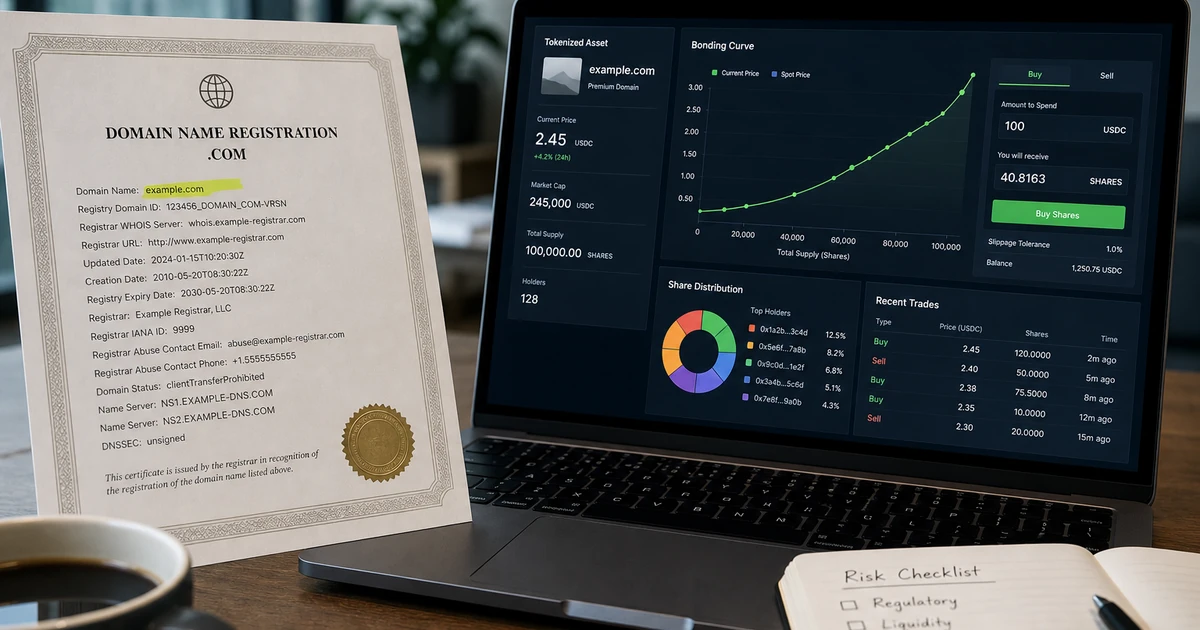
In plain English: the domain becomes an on-chain ownership token, then that token can be fractionalized into fungible shares people trade. Doma's docs describe fractionalization contracts, launchpad liquidity, and a buyout path where someone can pay a set price to reclaim the whole NFT and take the domain out of fractional status. Holders then redeem against buyout proceeds instead of "owning DNS."
Here's the operator view I care about:
- Confirm the domain is actually controlled by the party fractionalizing it — WHOIS, registrar lock, and platform custody disclosures. Don't skip this.
- Read who sets the initial valuation. On Smoothie, the owners set $3.5M. That is their ask, not an independent appraisal stamped by NameBio.
- Check what percentage is tokenized. Ten percent leaves the Castellos in control. Ninety percent would feel very different.
- Understand the buyout rules before you click buy. If a whale can buy out the NFT, your upside thesis changes overnight.
- Separate "trading a token" from "owning a transferable .com at a registrar." Escrow for whole-domain purchases still works the old way — auth code, unlock, release. Different product.
- Assume no dividends unless the docs say otherwise. You're buying narrative and exit optionality, not cash flow from the parking page.
If that list feels heavier than "ape the chart," good. Premium domains reward patience. Tokens reward attention. Different sports.
| Model | What you control | Typical ticket | Main risk |
|---|---|---|---|
| Buy whole domain (escrow) | Full registrar ownership | $1K–$10M+ | Illiquidity, carry, wrong thesis |
| Lease-to-own / installment | Path to ownership over time | Monthly + balloon | Default, seller terms |
| Fractional tokens (Doma-style) | Economic exposure, not DNS admin | Small tickets | Valuation, liquidity, buyout, platform |
| Park and wait | Full ownership, zero product | Renewal fees | Opportunity cost |
For negotiation hygiene on whole names, our buyer FAQ still covers escrow timelines better than any token UI. Use the right tool for the job.
Is fractional domain investing safe for beginners?
No — not if "safe" means "behaves like a GoDaddy hand-reg." Fractional domain ownership sits at the intersection of premium aftermarket pricing and crypto market structure. You can lose money on token price even if Smoothie.com remains a fantastic domain. Those are not the same outcome.
Risks I'd write on a sticky note before funding a wallet:
- Valuation risk. $3.5M is an owner-set mark. The aftermarket might clear higher or lower in a true bilateral sale.
- Liquidity risk. Early charts look exciting. Exits can vanish when narrative cools.
- Control risk. You don't run DNS. The owner does. That's by design — and it's a feature for the Castellos, a constraint for you.
- Platform / smart-contract risk. New rails. Read the Doma fractionalization docs, not just the launch thread.
- Regulatory fog. Tokenized claims on real-world assets attract questions. I'm not your lawyer. Don't pretend a blog post is counsel.
Honestly, if you've never closed a five-figure domain through escrow, I would learn that muscle first. Own one boring .com end-to-end. Feel the registrar transfer. Then decide whether fractional exposure belongs in your stack.
Why traditional domainers suddenly care
Three messy reasons — not a framework slide.
First, recognition. Doma needed a marquee .com. Smoothie.com is that kind of string. Jackson's piece makes the Field of Dreams problem explicit: build it, then pray the bats show up. A Castello listing is a bat.
Second, peer pressure among OGs. When Hall of Fame sellers experiment in public, the rest of the portfolio class pays attention even if they hate crypto Twitter. I've watched that social proof move markets before — slower than memecoins, stickier than hype threads.
Third, capital access. Category .coms at multi-million ask prices lock out almost everyone. Fractional tickets let smaller capital express a view. Whether that capital is sophisticated is another question. Volume will tell.
Meanwhile the broader registration base just crossed 401.6 million names in Verisign's Q2 2026 Domain Name Industry Brief — a reminder the namespace keeps expanding even as trophy .coms get scarcer. More names does not mean more Smoothie.com equivalents. Scarcity at the top is the point.
For price context on reported closes, I still start at NameBio and the weekly charts on DNJournal. Tokens don't replace comps. They sit beside them awkwardly until we have years of buyout data.
What should buyers and founders do with this?
If you're a founder who needs a brand tomorrow, fractional tokens on someone else's category name do not give you email, HTTPS, or App Store credibility. Buy or lease a domain you control. Browse the premium domain marketplace for names you can actually ship on — including category-forward .coms like FactoryArm.com when the product matches the string.
If you're an investor hunting upside without a seven-figure wire, fractional domain ownership is worth studying with a cold diligence checklist, not a hot wallet. Size positions like speculative venture tickets. Assume you can lose the stake. Sleep on it.
If you're a domain owner sitting on a true category .com, watch Smoothie's secondary market for a quarter before you copy the playbook. David Castello already flagged that other OGs are waiting. Being second with better terms beats being first with a bad structure.
And if you're comparing financing tools, re-read how installment structures work in our domain installment / BNPL piece. LTO solves a different problem: helping an end-user operator reach full ownership. Fractionalization solves a liquidity and access problem for investors. Don't mash them into one sentence.
How I'd diligence a fractional domain deal
- Identify the human seller and their track record. Castello-level reputation is rare.
- Verify the domain string, TLD, and that the platform listing matches the registrar reality.
- Write down the stated asset value, tokenized percentage, and fully diluted math on a napkin.
- Read buyout, fee, and custody language twice. Then once more when you're less excited.
- Ask what happens to content, email, and trademarks if the name later sells wholesale.
- Cap your spend at money you can ignore for twelve months. Attention is a cost too.
- Keep a parallel plan to own whole domains for any brand you actually operate.
Use domain tools for WHOIS and comps on the underlying string. Platform charts are not comps.
I'll keep watching this one with one eyebrow up. Fractional domain ownership finally has a serious .com on stage. Whether it becomes a durable market or a well-documented experiment depends on exits, not launch-day screenshots. If you've already traded a slice — or refused to — tell me what broke your thesis. I'm collecting the messy versions.