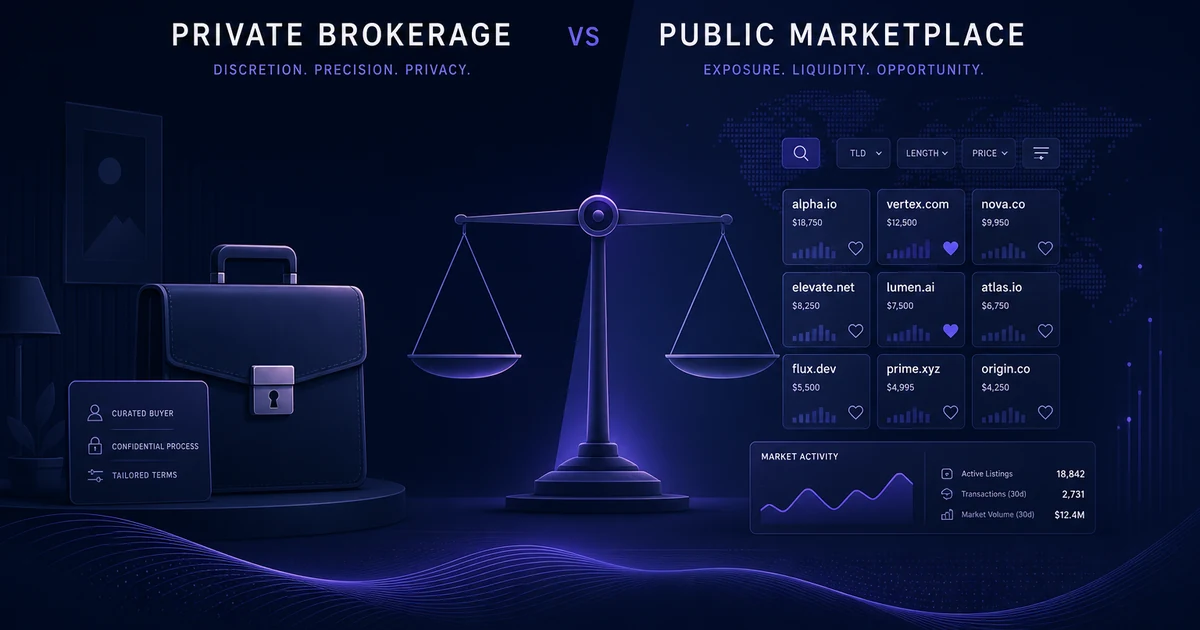
The Source.ai $200,000 private deal taught me something I already knew but kept forgetting under the pressure of a slow renewal month: not all domain names should be on a marketplace. Some names have exactly the right buyer — one buyer, maybe two — and a public listing is the worst possible way to find them. Private brokerage is the right tool for a specific kind of name. Most names aren't that kind. Getting the diagnosis right is most of the job.
Full disclosure: I have a bias toward public marketplaces. They're transparent, they move fast, and they reach buyers I'd never think to target myself. That bias cost me on one name a few years back — a short, strategic .com with one obvious buyer who would have paid significantly more than the BIN I'd set on Afternic. The right broker would have found that buyer and framed the value correctly. I used the easy channel instead. That's the mistake this piece is designed to help you avoid making in 2026.
I've tracked this pattern for years. My take is blunt. I'd rather be wrong in public than polish a empty framework. Honestly, the messy version is the useful one. That's the point. Not a theory. I've seen it fail the soft way. Hard truth. Buyers notice. Sellers forget. Period.
I've sold domains through Afternic, Sedo, Dan.com, and direct broker arrangements. Each channel has a use case. Mixing them up is how you leave money on the table or wait years for a sale that should have happened in months. The Source.ai $200K private close is a clean illustration of when brokerage wins. This piece is the framework for applying the same logic to your actual inventory. Before diving in, it's worth reading the Afternic request-price lander update coverage — that change has made the public marketplace channel meaningfully more effective for mid-market names in 2026, which affects where the brokerage calculus makes sense.
For primary sources I keep coming back to Google's Search docs.
When does a public marketplace beat private brokerage?
Most of the time, for most names. That's the honest starting point and I won't soften it.
Public marketplaces — Afternic, Sedo, Atom — have advantages that are genuinely hard to replicate through private channels. Scale. Organic reach. Buyer discovery from people who don't know what they want until they search a keyword and find your listing. If you're holding a solid .com with good phonetics and clear category association, a well-priced Afternic listing with BIN enabled will find its buyer. That buyer might be in a country you didn't target. An industry you never considered. A use case that would never have occurred to you. Marketplaces catch the accidental discovery that no broker's contact list can replicate — because no broker's contact list is that large.
The data from NameBio supports this directly. The overwhelming majority of five-figure domain sales run through verified public channels. Private deals exist and they matter, but they're the exception in volume terms, not the norm. Afternic's distribution network reaches buyers through thousands of registrar partnerships globally. You can't replicate that reach through personal relationships, no matter how warm they are. For solid inventory without a clearly identifiable buyer pool, discovery is the whole game. Marketplaces win on discovery.
Browse our premium domain listings to see names priced for discovery — strong brandables and keyword assets where the public marketplace channel is exactly right. The AiFolio.app listing is one example of how we position a focused AI SaaS name for the right buyer without exclusive private arrangements — it's publicly accessible because the buyer pool for AI SaaS names is wider than any private broker's network reaches.
When does private brokerage actually earn its commission?
Three scenarios, from most to least obvious. All three are real. None of them apply to most of your inventory.
Strategic buyer, small identifiable pool. If your name has obvious, attributable value to a specific company or category — a one-word descriptor for an AI data company, an exact-match brand for a specific industry vertical, a personal name .com for someone with a public profile — you can often identify the three to five most likely buyers and approach them directly through a broker who knows them. A broker with warm relationships in that buyer community is worth every point of commission. Source.ai through fruits.co / OpusDNS is this scenario precisely: the right buyer pool was small, the broker knew them, and the deal closed at a number a public BIN would never have produced.
Seller privacy required. Sometimes the seller can't publicly advertise a domain sale without signaling something they'd prefer to keep quiet — a rebrand in progress, a portfolio cleanup before a financing round, a pivot the board hasn't announced yet. Private brokerage lets you work the market without a public listing that gets screenshotted and posted on domain forums before you've made your first call. I've seen sellers lose negotiating position because a forum post created artificial urgency around a name they'd barely started shopping. Private arrangements prevent that entirely. The privacy use case alone justifies the brokerage structure for some sellers.
Price discovery without anchoring. Some names are genuinely hard to price — no clean comps, unusual extension, brand-adjacent to multiple industries in ways that make category-based pricing unreliable. A public BIN anchors the conversation at whatever number you chose. A broker can run soft market conversations that establish real buyer appetite before any price is put in writing. You sometimes end up with a more accurate outcome than a listing would have produced. Not always. But this is a legitimate use case when the pricing uncertainty is real and your time horizon allows for a longer process.
ChannelBest forTypical feeWatch out for Afternic / Sedo public listingBrandables, standard keyword assets, wide buyer pool15–20% marketplace feePrice anchoring below private channel potential Private broker, exclusive arrangementStrategic names, small identifiable buyer pool of 3–510–20% commission6-month lock-in if broker's network is thin Private broker, non-exclusiveTransition names — solid but with strategic upside10–20% if broker-sourcedCommission sourcing disputes at close Direct seller outreachOne obvious ideal buyer you can identify and reach0% commissionTime-intensive, no intermediary protectionWhat does private brokerage actually cost — and how do you run the math?
Commissions vary. Ten to twenty percent is standard for U.S.-based domain brokers. High-value names sometimes see tiered structures — lower percentage above a threshold, higher below it. Exclusive arrangements typically run three to six months with renewal options. Some brokers charge a monthly retainer against the commission. Know the full structure before you sign.
The math only works when the broker can credibly access buyers your marketplace listing wouldn't reach, and when the expected price with brokerage exceeds the expected price without it by more than the commission differential. That sounds obvious. It isn't, in practice, because brokers often take exclusive arrangements on names they can't materially improve the outcome for. The worst scenario in domain investing isn't a low sale price — it's a six-month exclusive period with a broker whose buyer network doesn't overlap with your name's actual buyer profile. You've paid opportunity cost and commission for nothing, and you can't list publicly during that window.
Ask the broker directly before signing: who are the three most likely buyers for this specific name, and what is your existing relationship with each of them? If the answer is vague, that's your answer. I'd also check their recent closes through DNJournal — major private sales get reported when sellers disclose, and a broker's deal history in your category tells you more than any pitch conversation. Our acquisition FAQ covers commission structures and exclusivity clause language worth checking before you commit.
Can I use both channels for the same name — and should I?
Yes, with explicit caveats. Non-exclusive broker arrangements let you maintain marketplace listings while a broker works private channels simultaneously. This approach works well for names at the transition point: solid enough that a marketplace listing makes sense for broad discovery, strategic enough that a broker might surface a premium buyer the public listing wouldn't find on its own. The risk is commission sourcing confusion when a sale closes — build explicit language into any broker agreement about what constitutes a broker-sourced lead before you sign. Some brokers count any buyer they've had a conversation with as broker-sourced, regardless of whether that buyer found you through Afternic first. That dispute is not one you want to be navigating while trying to close a $40K deal.
Track which inquiries come through which channel for at least 90 days before deciding whether the broker relationship is earning its keep. If 90 days produces zero broker-sourced inquiries on a name with an active marketplace listing that's getting consistent contact, the broker isn't adding value. That's information. Act on it — either renegotiate or end the arrangement, depending on your agreement terms. Our domain tools page has resources for evaluating broker track records and checking category-level comp data before you negotiate commission terms. Understanding what your name is likely to clear at in each channel is the foundation of making the right channel decision, and that starts with real data, not aspirational pricing based on headline sales.
My honest take on where most investors go wrong: they over-index on private brokerage for names that are good but not exceptional. Good names with broad buyer pools belong on marketplaces, priced competitively with BIN enabled and transfer friction removed. Exceptional names with attributable strategic value to a specific, funded buyer pool benefit from private brokerage. The mistake is letting the aspiration of a Source.ai-style outcome drive you toward a brokerage channel that the name doesn't actually support. Know which category your best names fall into before you decide where they live.
Key Takeaways
- Public marketplaces win on discovery and volume — most domain names, including solid brandables and standard keyword assets, belong there with competitive pricing and BIN enabled.
- Private brokerage earns its commission when the buyer pool is small, identifiable, and reachable through warm relationships — not for inventory described as "solid" or "brandable."
- Seller privacy and price discovery are legitimate, non-obvious use cases for private arrangements, beyond the more obvious strategic buyer targeting scenario.
- Exclusive broker deals carry real opportunity cost — vet track records and buyer network overlap specifically before you sign any six-month exclusive arrangement.
- Non-exclusive dual-channel setups can work for transition-point names; build explicit commission sourcing language into the broker agreement from day one to avoid close-time disputes.
Most domain investors I know default to marketplace listings because it's easier. That's fine for most inventory. The Source.ai story is a reminder that easier and optimal aren't the same thing for the names that deserve a different approach. Figure out which category your best names fall into, then use the right channel — not just the convenient one.
- Decide the outcome you want before you call anyone in 2026.
- Pick the channel — private brokerage or a public marketplace listing.
- Verify ownership, history, and trademark risk yourself.
- Agree terms in writing and move money through escrow.
- Confirm the registrar transfer before you release funds.