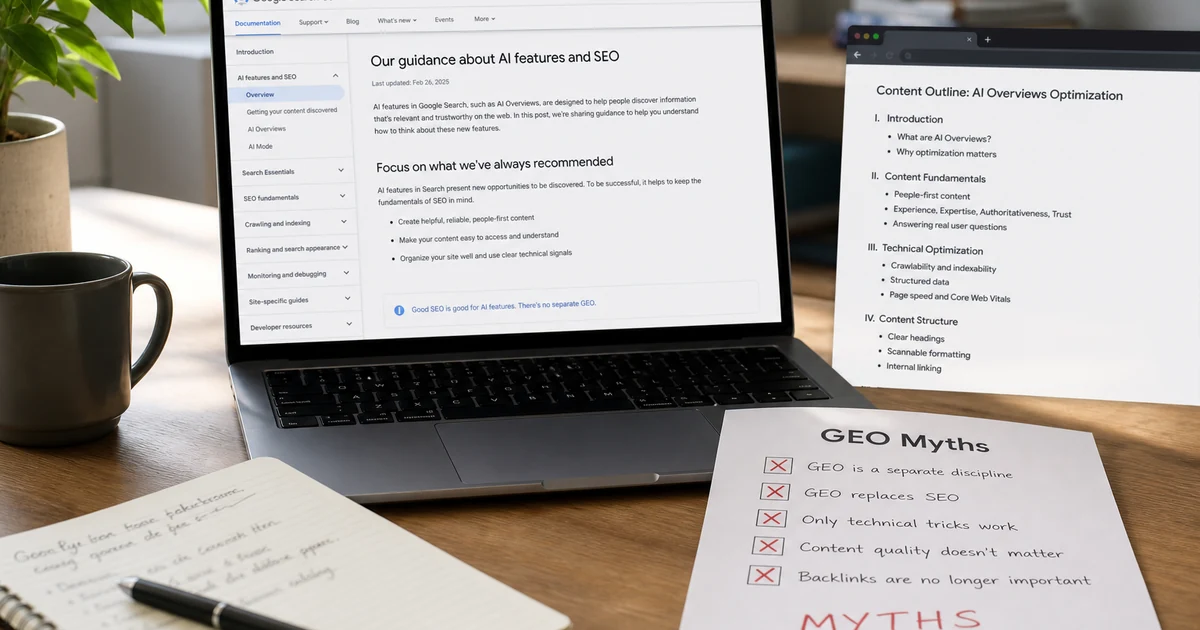
Every week someone emails me asking how to "do GEO" like it's a secret handshake. So when Google's Search Central team published guidance in June 2026 saying, essentially, that optimizing for generative AI is still just SEO, I felt weirdly vindicated.
Generative engine optimization — GEO, if you like acronyms — got sold to a lot of nervous marketers as a brand-new discipline requiring brand-new files and brand-new consultants. Google's own position is more grounded, and it's worth reading carefully before you spend a budget.
Here's what the guidance actually says, where the myths crept in, and which GEO habits genuinely help your classic rankings too.
I want to be careful here, because there's a version of this article that just contradicts Google to sound edgy. That's not this one. Google's guidance is accurate, and my job is to translate it into what you should actually do on Monday morning.
What does Google actually say about GEO?
The core message from Google Search Central is blunt: there's no separate rulebook for showing up in AI Overviews or AI Mode. The same content that earns strong organic rankings is the content that gets pulled into generative answers.
That means the fundamentals haven't changed. Helpful, reliable, people-first content. Crawlable pages. Clear structure. Good signals of expertise and trust. If you were doing those things well, you were already "doing GEO" without the label.
Google paired this with new controls for website owners, giving publishers more say over how content is used. But controls are not a ranking hack — they're governance. Don't confuse the two.
GEO isn't a new door into Google. It's the same door, and the key is still content quality.
I find this refreshing because it kills a lot of snake oil. You don't need a magic schema, a secret prompt, or a paid "AI visibility score." You need pages worth citing.
Is llms.txt required for AI search? (No — but read this)
Let me be precise, because this is where I see the most confusion. Google does not require an llms.txt file to appear in AI experiences. It is not a ranking factor, and skipping it will not remove you from AI Overviews.
So why do we publish our llms.txt anyway? Because it's a low-cost, plain-language summary of what our site is and what matters on it. It hurts nothing, it clarifies our positioning, and some AI tools outside Google do read it.
That's the honest framing. Treat llms.txt as optional housekeeping, not a requirement. Anyone telling you it's mandatory for Google is contradicting Google's own guidance — and I'd be skeptical of the rest of their advice too.
The bigger point: don't chase files. Chase clarity. A tidy site with self-contained, well-labeled content is legible to both crawlers and language models without any special ceremony.
Which GEO practices actually help classic SEO?
Here's the fun part. Most of the "GEO tactics" floating around are just good SEO wearing a hoodie. When I strip the hype, a handful genuinely move the needle for both AI citations and traditional rankings.
- Self-contained passages. Write sections that answer a question completely in 130-170 words, so they can be lifted cleanly. This also improves featured snippet eligibility.
- Clear headings phrased as questions. They map to how people actually query AI systems and they've helped classic FAQ snippets for years.
- Strong entity signals. Name your brand, products, and topics consistently so systems can connect them. Ambiguity is the enemy of citation.
- First-hand experience and data. Original insight is harder to summarize away and easier to cite as a source.
- Fast, clean, crawlable pages. If a bot can't reach it, no AI can quote it.
Notice what's missing from that list: gimmicks. No keyword stuffing, no hidden text for robots, no "AI-optimized" template you buy for $499. The work is the work, and I've said as much in previous SEO analysis.
What does this mean for your 2026 strategy?
If you've been paralyzed waiting for the "real" GEO playbook, stop waiting. Google just told you it's the SEO playbook you already have. Spend your energy on depth, credibility, and structure — not on reformatting everything into some AI-specific dialect.
Practically, I'd audit my top pages for how self-contained each key section is, make sure my brand and entities are named consistently, and confirm nothing important is blocked from crawling. That's a weekend, not a re-platform.
And I'd resist the urge to publish more just to "feed the AI." Volume for its own sake is what got so many sites buried in the helpful content updates. One genuinely authoritative page beats ten shallow ones that summarize each other into noise.
The teams I see winning in 2026 are the ones who treated the GEO panic as permission to double down on quality, not to chase a new format. That's the quiet advantage hiding in Google's guidance — it rewards the discipline most people won't maintain.
So if you take one thing from Google's June guidance, make it this: stop looking for a shortcut that doesn't exist, and start compounding the fundamentals that always have. The label on the door changed from SEO to GEO, but the room behind it is the same one you already know how to work in.
For brands and startups, there's a naming angle here too. Consistent, distinctive brand entities are easier for AI systems to attribute — and that starts with a domain that reads like a real brand. Our AI domain category is full of names built exactly for that kind of clean attribution.
How do you spot GEO snake oil?
Since Google put its position in writing, the fastest way to evaluate any GEO advice is to check it against the official guidance. If a vendor's pitch contradicts Google directly, that's your answer.
A few red flags I've learned to trust. Anyone who says llms.txt is required for Google is wrong, full stop. Anyone selling a proprietary "AI schema" that supposedly forces citations is guessing. And anyone promising a fixed "AI visibility score" is inventing a metric they alone control.
Compare that to what Google actually rewards, and the contrast is stark. Real advice sounds unglamorous: write helpful content, structure it clearly, earn genuine trust, keep the site crawlable. It doesn't fit on a sales landing page because it can't be gatekept.
If the tactic only works because someone sells you access to it, it's probably not how search works.
My rule is simple. Before paying for any GEO tool or course, I open the Search Central blog and check whether the claim survives contact with Google's own words. Most don't.
My blunt advice: ignore anyone charging premium rates to "unlock GEO." Read Google's guidance, fix your fundamentals, and pocket the money. If you want a name that AI answers can cite cleanly, browse our current inventory or check the acquisition FAQ for how transfers work.
— DN Detector editorial